
What to Do When Your Garage Door Won't Open or Close: A Central Ohio Guide
It always happens at the worst time. You're loading the car for a trip. You're trying to leave for work. The kids need to be picked up. Suddenly, the garage door makes a horrible noise, refuses to open, gets stuck halfway, or slams shut with a bang and won't move again. If you live in central Ohio and have ever stood in your garage staring at a door that won't cooperate, you know the helpless feeling. The good news is that most garage door emergencies have a few quick things you can try before calling for help, and knowing what's safe to do (and what's not) makes all the difference.
Homes in this area deal with seasonal temperature swings and wear patterns that often affect key components, especially Garage Door Springs, which are one of the most common causes of sudden door failure. We put together this guide for emergency garage door tips delaware dublin hilliard residents specifically, because central Ohio weather and home styles bring some specific patterns that other parts of the country don't see.
Common Garage Door Emergencies in Central Ohio
Before getting into what to do, here's what we typically see across Delaware, Dublin, Hilliard, and the surrounding suburbs:
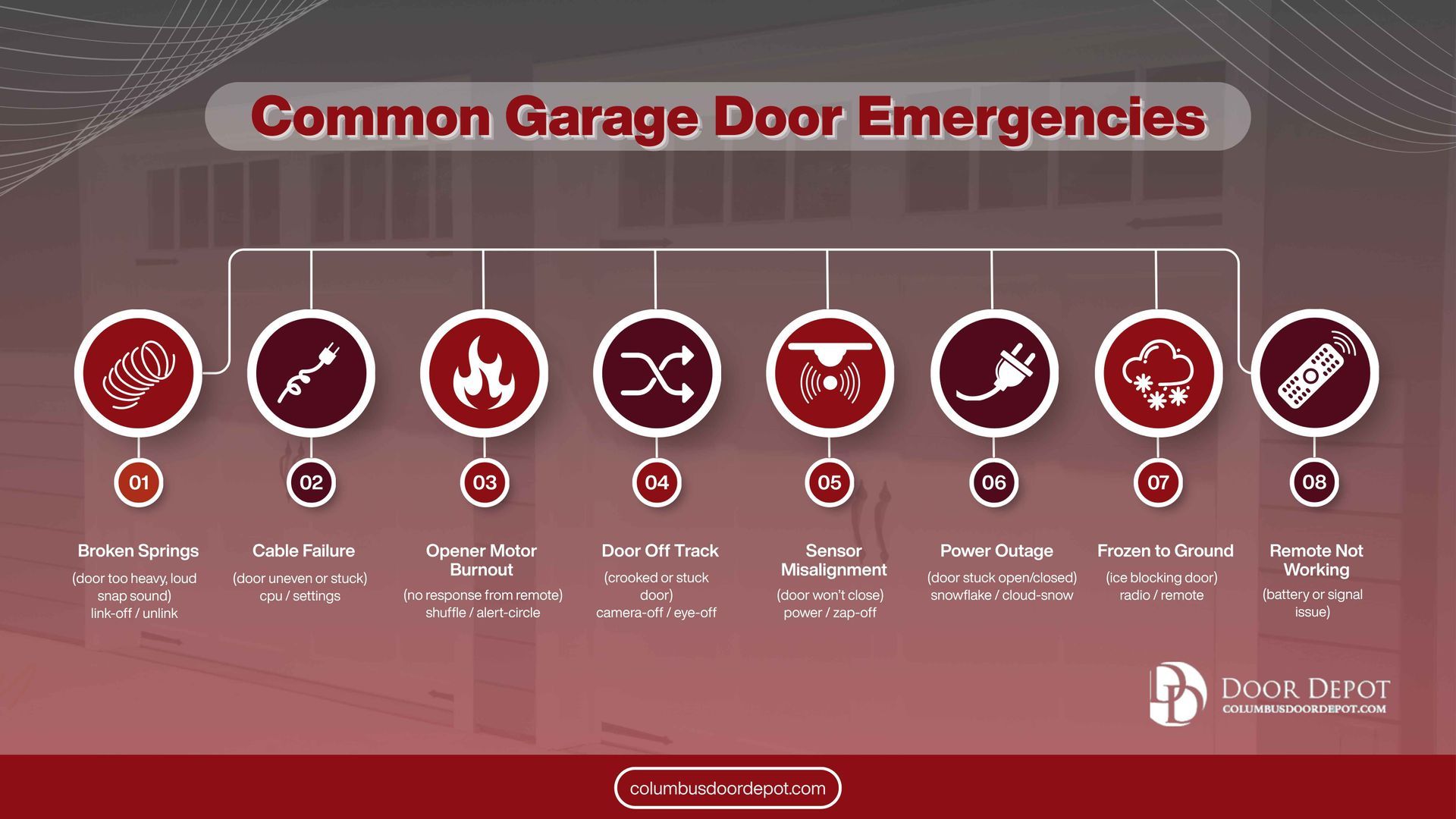
Broken springs: The most common emergency. Usually happens during a temperature drop or after years of use. Sounds like a gunshot in the garage. The door becomes too heavy to lift, and the opener strains or fails.
Cable failure: Cables that lift the door snap or come off the drum. The door can become uneven or stuck halfway. Often related to spring failure.
Opener motor burnout: The motor finally gives up, especially after years of working harder than it should because the springs were weakening. The door doesn't respond to the remote or the wall button.
Door off track: Usually from a spring or cable failure, sometimes from impact (cars, tall objects). The rollers come out of the track, and the door is stuck or hanging crooked.
Sensor misalignment: The safety sensors at the bottom of the door tracks get bumped or dirty, and the door won't close. Easy to fix in most cases.
Power outage during use: The door is stuck open or closed when the power goes out. Many homeowners don't realize they can manually disconnect.
Frozen to the ground: Winter ice or snow freezes the bottom seal to the concrete. The door won't open, or it tries and tears the seal.
Remote not working: Battery dead, signal blocked, or programming lost. Usually, a simple fix.
Step One: Don't Force It
The single most important rule in any garage door emergency is to stop trying to operate the door if it's not behaving normally. Garage doors are heavy and store a lot of energy in their springs and cables. Forcing a broken door can:
- Snap a cable that whips around the garage
- Pull a spring loose under tension
- Damage panels permanently
- Drop the door on a person, vehicle, or pet
- Damage the opener beyond repair
- Bend the tracks so a simple problem becomes a major one
If the door makes an unusual noise, moves crookedly, or stops mid-cycle, stop trying to use it. Step away. Assess the situation calmly.
Step Two: Check the Easy Stuff First
A surprising number of "emergencies" turn out to be simple problems with simple fixes. Run through these before assuming something is broken:
- Check the opener power: Is the unit plugged in? Did the breaker trip? Is the outlet working? Sometimes the answer is genuinely that simple.
- Check the wall button: Does the wall-mounted button respond? If it does, but the remote doesn't, the issue is the remote, not the door.
- Check the remote battery: Open the remote and replace the battery. Many "dead opener" calls turn out to be a $2 battery.
- Look at the safety sensors: The two small electronic eyes at the bottom of the tracks need to be aligned and clear of obstructions. If one isn't lit, gently rotate it until both indicators are solid. Wipe off the lenses with a clean cloth.
- Check the lock function: Some openers have a vacation lock mode that disables operation. Make sure it isn't engaged.
- Look for obstructions: Anything in the path of the door, including a stored item, a leaf pile, or a frozen patch of ice, can cause the door to refuse to close.
- Check the manual disconnect cord: If the cord is pulled, the door is in manual mode and won't respond to the opener. Pulling it again toward the door (not the motor) re-engages it.
These take about five minutes to run through and solve a meaningful percentage of "garage door won't work" calls.
Step Three: Use the Manual Release if Needed
If you need to get a vehicle in or out of the garage door opener isn't working, you can usually disconnect the door from the opener and operate it manually. Look for a red cord hanging from the opener rail near the door. That's the emergency release.
To use it:
- Make sure the door is fully closed if possible.
- Pull the red cord straight down. You'll feel the carriage disconnect.
- Lift the door manually using the handle.
- The door will be heavy, especially if the springs are broken. Don't try to lift if you can't manage it safely.
- Once the door is open, drive your vehicle in or out.
- Close the door manually.
- Lock the door if you'll be leaving it disconnected for a while.
Important warning: Do not pull the manual release while the door is in the open position unless you have someone supporting it. If the springs are broken, the door can crash down with serious force.
Things You Should Never Try Yourself
Some garage door problems need professional handling. Don't attempt:
Spring replacement: Torsion springs hold hundreds of pounds of stored energy. Replacing them without the right tools and training can cause serious injury or death. This is the number one DIY mistake we see.
Cable rethreading or replacement: Cables are also under high tension and can whip dangerously when handled incorrectly.
Re-tracking the door: A door off its tracks usually has another underlying problem. Just shoving it back into the track can cause more damage.
Opener adjustment beyond basic settings: Force settings and travel limits should be done by someone who knows what they're adjusting and why.
Welding or major panel repair: Damaged panels often need replacement, not patching. DIY repairs rarely hold and may compromise the door's structural integrity.
If any of these are involved in your situation, stop and call a pro.
Winter-Specific Issues for Central Ohio
Central Ohio winters bring some specific garage door problems that don't happen the rest of the year:
Doors frozen to the ground: The rubber bottom seal can freeze to the concrete after a wet day followed by a hard freeze. Don't force the door open. You'll tear the seal or the panel. Instead, use a heat gun, hair dryer, or warm water (carefully) to thaw the seal before trying to open.
Stiff springs in cold weather: Cold metal is less flexible. Springs that are weakened from age often fail on the coldest mornings. If your door has been getting heavier or noisier through fall, get it checked before winter sets in.
Frozen tracks: Ice and slush can build up in the tracks and prevent rollers from moving smoothly. Clear the tracks before forcing the door.
Salt and grit damage: Road salt brought into the garage on tires accelerates corrosion on metal hardware. Clean the tracks and rollers periodically through winter and apply appropriate lubricant.
Power outages from storms: Central Ohio gets ice storms and snowstorms that knock out power. Know how to use the manual release before you need it.
Summer Issues to Watch For
Summer brings different problems:
Overheated openers. Direct sun on the garage and high indoor temperatures can cause the opener motor to trip its thermal cutoff. The door stops working until it cools down. Improving garage ventilation helps.
Expanding metal causing binding. Warm tracks can pinch rollers, especially on hot afternoons. Doors that worked fine in winter may struggle in July.
Storm damage. Summer thunderstorms can knock branches into the door or send flying debris through panels. Inspect after any major storm.
When to Call a Professional
Some situations are clear emergencies that need a pro fast. Call right away if:
- A spring has visibly broken (you'll hear the bang)
- A cable has snapped or come off the drum
- The door is hanging crooked or off track
- You can't lift the door manually because it's too heavy
- The door has fallen partially or completely
- A panel is severely damaged
- The opener motor is smoking, hot, or making burning smells
- A vehicle has hit the door
- Someone has been hurt by the door
In any of these cases, don't try to fix it yourself. Contain the area, keep kids and pets clear, and call for help.
How to Avoid Most Emergencies
Most garage door emergencies are preventable with basic maintenance. The list is short and not difficult:
- Lubricate rollers, hinges, and springs twice a year with proper garage door lube
- Inspect the door visually every few months
- Listen for new noises and address them early
- Test the safety reverse function monthly
- Keep the tracks clean and clear
- Check the bottom seal for cracks and replace as needed
- Schedule a yearly tune-up with a qualified technician
- Don't ignore warning signs like sluggish operation or strange sounds
A door that gets a little attention every year rarely has the kind of catastrophic failures we get called out for after years of neglect.
Wrapping Up
Garage door emergencies are stressful, but most of them have a clear path to resolution if you know what to check, what to try, and when to call for help. The basics are: don't force a broken door, check the easy stuff first, use the manual release when needed, and call a pro for anything involving springs, cables, or major damage. Knowing this in advance turns a panicked moment into a manageable one.
When you need help fast in central Ohio, we're ready to come out and handle it.
At Columbus Door Depot, we serve homeowners across Delaware, Dublin, Hilliard, and the surrounding areas, and we know the kinds of issues that show up in this region. Give us a call when you're ready, and we'll take care of it.
FAQs
My garage door won't open at all. What should I check first?
Start with the simple things. Make sure the opener is plugged in, and the breaker hasn't tripped. Check the remote battery. Verify the wall button works. Look at the safety sensors at the bottom of the tracks. Sometimes the door is also in manual disconnect mode, which is easy to fix.
Can I open my garage door manually if the power is out?
Yes, in most cases. Pull the red emergency release cord hanging from the opener rail. This disconnects the door from the opener so you can lift it by hand. Make sure the door isn't broken first, since a door with a broken spring will be too heavy to lift safely.
Is it safe to fix a broken garage door spring myself?
No. Garage door torsion springs hold hundreds of pounds of stored energy and can cause serious injury or death if mishandled. Spring replacement requires specialized tools and training. This is one of the most common causes of DIY garage door injuries. Always call a qualified technician for spring work.
Why does my garage door reverse when I try to close it?
Usually, the safety sensors are blocked, dirty, or misaligned. Check the two electronic eyes at the bottom of the tracks. Make sure both indicator lights are solid. Wipe the lenses clean. If the sensors are fine, the issue may be with the opener's force or limit settings, which need professional adjustment.
How much does an emergency garage door repair usually cost in central Ohio?
Costs vary by issue. Simple repairs like sensor adjustments or remote programming run $75 to $200. Spring replacements typically cost $250 to $600, depending on type. Cable replacements are similar. Major damage or full replacements cost more. After-hours emergency calls often add a premium of $100 to $300.