
Slack, Frayed, or Snapped: The Garage Door Cable Explained From the Floor
A broken garage door cable is almost never a cable problem on its own. The lift cables are the last link between the springs and the bottom of the door, so when one hangs slack, frays or snaps, the question that matters is what happened to the tension it was carrying. You can answer most of that from the garage floor without touching anything, and that is exactly where you should stay.
TL;DR
A broken garage door cable is a symptom of the counterbalance system, not a stand-alone part failure. Each lift cable on a torsion-spring door runs from a bracket at the bottom corner of the door up to a drum on the spring shaft, and spring tension is what keeps it wound tight.
Extension-spring doors carry two kinds of cable: lifting cables and separate safety cables that run through the springs to contain them if one breaks. A cable that has gone slack or jumped its drum usually means one side of the door stopped moving while the other kept going, which in a central Ohio winter is often a door frozen to the slab. The bottom bracket the cable hooks onto is under extreme spring tension, and the industry labels it that way. Look, photograph, unplug the opener, and leave the hardware alone.
Which Cable Is Hanging There?
There are two different cable systems on residential sectional doors, and they fail differently. Before anything else, look up at the spring. A single long spring on a bar above the top of the door means torsion. Two long springs running alongside the horizontal tracks, parallel to the ceiling, mean extension.
The
Amarr residential steel door installation instructions show both. On a torsion door, the lift cable is hooked over a lifting stud on the bottom bracket, run up between the door and the track, and hooked into a notch on a drum at the end of the spring shaft. The drum is turned by hand until the cable is snug, and then the spring is wound. For an extension door, the same manufacturer supplies four or six cables: the longer ones lift the door, and the shorter ones are safety retention cables that loop around the hanger angle and run through the centre of the spring.
| What you see overhead | Spring type | Cables on the door | What a failure usually looks like |
|---|---|---|---|
| One spring on a shaft above the opening | Torsion | One lift cable per side, wound on a drum | Cable unwound and hanging, door crooked or stuck |
| Two springs beside the ceiling tracks | Extension | Lifting cables over pulleys, plus a safety cable through each spring | Lifting cable snapped, or a spring broken and held only by its safety cable |
| A tube with the springs hidden inside | Torsion, enclosed | Lift cables on drums at each end of the tube | Same as torsion, but the drum is harder to see |
That second row matters more than it looks. If an extension spring has broken and the pieces are hanging on a cable running through it, the safety cable did its job. That is not the cable that failed. DASMA's general inspection guidelines for sectional doors list an extension spring containment system installed per the manufacturer's documentation as a line item a code official should confirm, which tells you how seriously the industry treats it.
When there is no safety cable at all
Older extension-spring doors sometimes have no containment cable, or had it removed during a past repair. If you look up at a pair of extension springs and cannot see a cable running through the middle of each one, stay out from under them. A spring that breaks without containment has nothing to stop it. Mention it when you call, because the repair should put containment back.
What Does a Broken Garage Door Cable Look Like From the Floor?
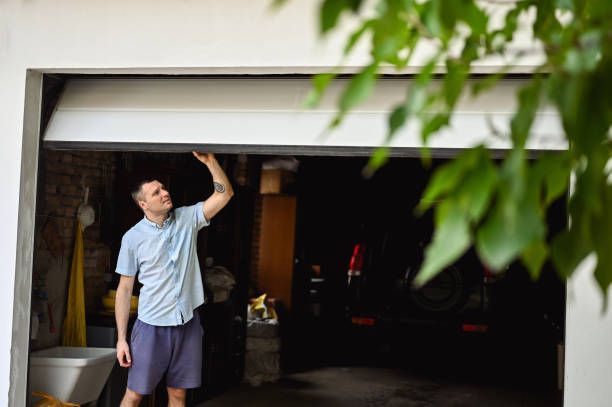
A broken garage door cable shows up as one of four things: a cable lying slack or coiled near the bottom corner, a door sitting crooked in the opening, a door that stops partway and will not go further, or a cable that is visibly frayed where it runs past the drum or bracket. Each points somewhere different.
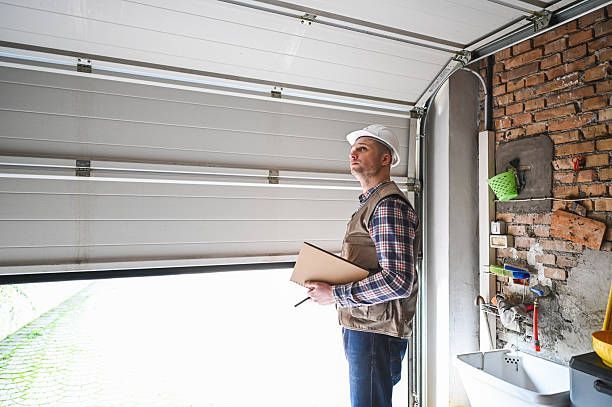
Stand back, where you could step clear if something moved, and compare both sides of the door. Most of the diagnosis is in the difference between left and right.
| From the floor you see | What it usually means | Safe for you to do |
|---|---|---|
| One cable slack, door level and closed | Cable has unwound from its drum; spring may still be intact | Unplug the opener and leave the door closed |
| Door crooked, one side higher | One cable is carrying the door and the other is not | Keep everyone out of the opening; do not try to lower it by hand |
| Cable in pieces, spring intact | The cable itself failed, usually at a worn spot | Photograph both sides and call |
| Spring in two pieces, cable slack | The spring broke first, and the cable lost its tension | Do not use the opener or the manual release |
| Frayed strands near the bottom bracket | Wear or corrosion at the point of highest load | Stop using the door until it has been looked at |
The detail worth photographing
Take a picture of each bottom corner of the door and each end of the spring shaft, from a distance. The photo of the drum shows whether the cable came off the grooves or snapped. The photo of the bottom corner shows whether the bracket is still seated. Those two pictures tell a technician more over the phone than any description will.
Why Did the Cable Come Off the Drum?
It came off because it lost tension. That is the short answer, and every specific cause is a version of it.
A lift cable stays in the grooves of its drum only while the spring is pulling on it. Amarr's instructions make the point indirectly: during installation, the shaft is clamped with locking pliers "so that the cable does not loosen or unwind" while the spring is wound. Remove the pull on one side, even for a second, and the cable has nothing holding it in place. When the pull comes back, it can land outside the groove or wrap over itself.
The ordinary ways that happen:
- The spring broke: The drum stops being driven, and both cables go slack together. It is the first thing to rule out whenever a cable is found hanging.
- One side of the door stuck while the other moved: A bent track section, a roller that jumped out, or an object under one corner stops that side. The cable on the stuck side goes slack while the opener keeps pulling.
- The door was out of level with its tracks: The same Amarr document says the vertical tracks must be level with each other and the bottom of the track must match the bottom of the section. A door that sits lower on one side loads its cables unevenly every cycle.
- The cable wore through: Strands break one at a time, often where the cable bends around the drum or leaves the bottom bracket, until the rest let go.
The first cause is the spring, not the cable, and it changes the whole repair. If you can see a gap in the torsion spring, you are really looking at a spring job with cable work attached.
A Central Ohio Winter Adds a Cause Most Guides Skip
The second cause on that list has a seasonal version here. The bottom section of a steel door carries a rubber weather seal along its lower edge, and on a cold morning that seal can freeze to the concrete. If it lets go on one side first, that side jumps up while the frozen side stays put. The cable on the frozen side goes slack at the moment the opener is pulling hardest.
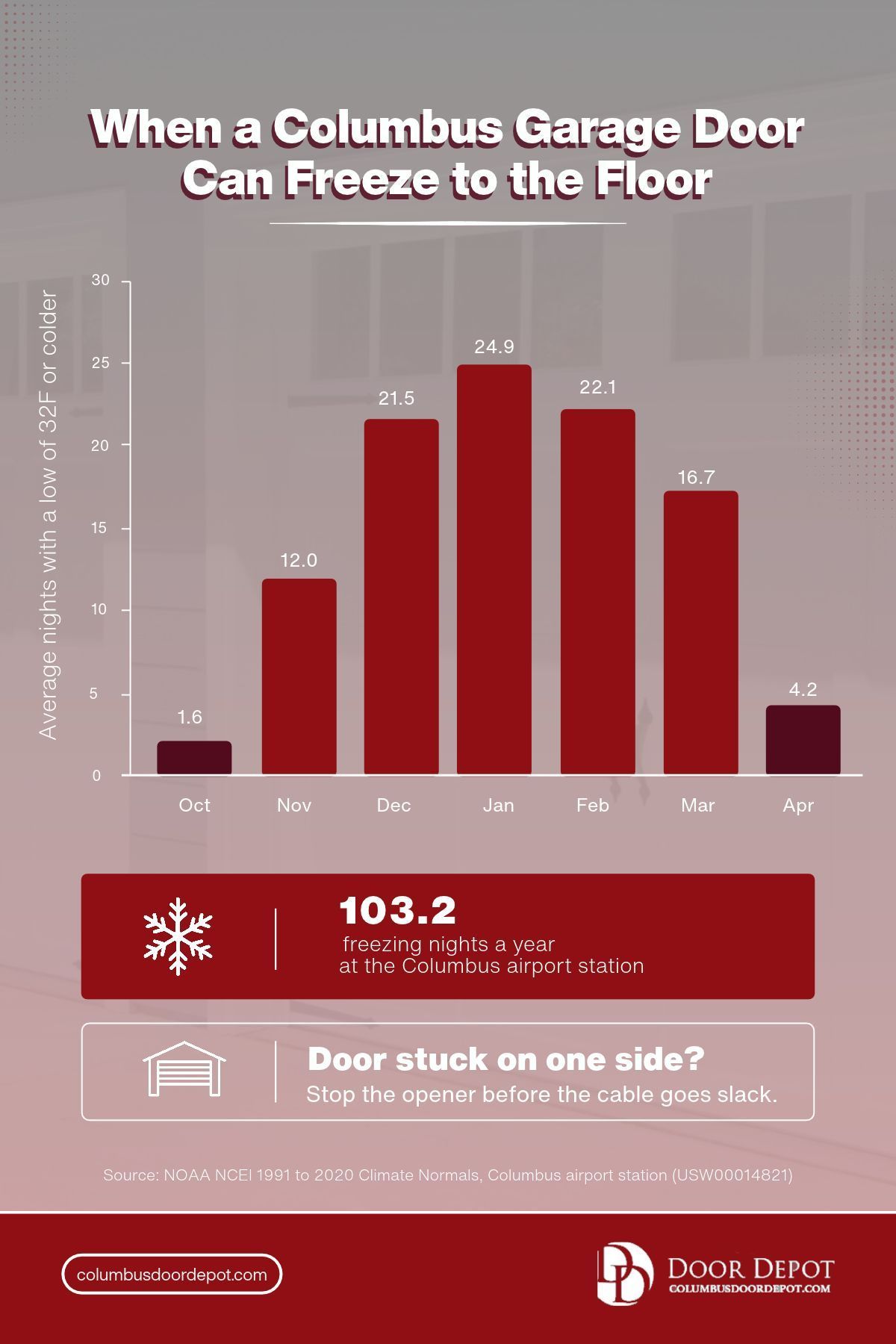
How often that can happen depends on how many cold mornings there are. NOAA's 1991 to 2020 climate normals for the weather station at John Glenn Columbus International Airport, on the east side next to Gahanna, are the fairest local measure.
| Measure at the Columbus airport station | 1991 to 2020 normal |
|---|---|
| Nights a year with a low of 32F or colder | 103.2 |
| Days a year with a high of 32F or colder | 27.6 |
| Date by which the first 32F night has arrived, in half of years | October 27 |
| Date after which a 32F night is unlikely, in half of years | April 18 |
| Freezing nights in January | 24.9 |
| Freezing nights in December | 21.5 |
| Freezing nights in November | 12.0 |
| Average annual snowfall | 28.2 inches |
Those figures come straight from the NCEI normals data, and the practical reading is simple. From late October to the middle of April, a Columbus garage door can start its morning frozen to the floor. Across the whole year, 103 freezing nights works out to a little more than one night in four. Snow melting off a car and pooling along the threshold makes a frozen seal more likely.
What to do on a frozen morning
If the door hesitates, groans, or lifts on one side only, let go of the button. Do not run it again to see if it frees itself. Break the ice at the seal from outside with warm water or a plastic scraper, give it a minute, and try once. A door that still will not lift evenly needs a look before it moves again.
The same advice holds across the metro, from Grove City to Lewis Center. Wherever meltwater collects at the threshold, that is where the seal will freeze first.
Is It Safe to Touch the Bottom Bracket?
No. The bracket at the bottom corner of the door, where the lift cable hooks on, carries the full force the spring puts into that side of the door. The industry puts a label on it for that reason.
DASMA's Technical Data Sheet 172, on garage door labels, describes a bottom bracket safety label whose job is to warn that a garage door bottom bracket is under extreme spring tension, and says it should be placed next to the bracket. Its general inspection guidelines, Technical Data Sheet 151, open with a warning addressed even to code officials: visually inspect components under spring tension, such as spring anchor brackets and parts to which cables are attached, and do not touch them.
Amarr's residential instructions go further. The first thing on the page is a danger notice saying not to remove, repair, or adjust any springs, any red fasteners, or the hardware those red fasteners are attached to, and that the work must be done by a trained garage door technician. The bottom bracket is fastened to the door with red screws.
| Part | Why it is dangerous | Who says so |
|---|---|---|
| Bottom bracket and its fasteners | Holds the lift cable against full spring tension | DASMA TDS 172, Amarr danger notice |
| Spring anchor bracket | Anchors the spring force to the wall | DASMA TDS 151 |
| Drum and set screws | Holds the wound cable on the shaft | Amarr torsion instructions |
| Extension spring and its pulley | Stores the lifting force along the track | Amarr extension instructions |
If the spring turns out to be the real failure, our garage door spring repair page explains what that visit involves. If the door is old enough that you are wondering whether to fix it at all, we wrote a separate piece on when an older door is still worth repairing.
When the cable is the only thing wrong
Sometimes it genuinely is. A cable can fray through at a worn spot on a door whose spring, drums, and track are all sound. That is a straightforward repair, and it is still one for a technician, because swapping the cable means taking the tension off the spring and winding it back on. We cover the drive up to Lewis Center and the rest of the northern suburbs for exactly this kind of call.
Around Columbus, the Pattern Repeats
Cable trouble looks the same in every suburb we drive to. What changes from house to house is which spring system is fitted, and that is the first thing to check wherever you are.
Either kind of door can turn up anywhere in Franklin County or Delaware County, so check yours rather than assuming. The table near the top of this page is the quickest way to tell yours apart. If it runs extension springs, look for the safety cables before anything else; if it runs torsion, look at the drums.
The freeze figures above come from the airport on the east side, next to Gahanna and not far from our shop on Westbourne Avenue. Hilliard and Dublin sit across town, but the season is the same: late October to mid-April.
None of that changes the rule. A cable that has let go on any door in Columbus is a spring-tension problem first.
Get the Door Checked Before It Moves Again
If a cable is slack, frayed, or in pieces, the door has already told you the tension is wrong somewhere. Leave it closed if it is closed, unplug the opener, take your photos, and call. Our technicians check the springs, both cables, and the balance of the door, then tell you plainly what you have: a cable job, a spring job, or a door that needs a bigger conversation.
Homeowners across Columbus, Dublin, Westerville, and Grove City can reach us through Columbus Door Depot, and a photo of each corner will get the conversation off to a faster start.
Frequently Asked Questions
Can I use my garage door with a broken garage door cable?
No. A broken garage door cable means one side of the door has lost its connection to the spring. Running the opener pulls the door unevenly and can bend panels or track. Unplug the opener, leave the door closed if it is closed, and have it inspected.
Why does my garage door cable keep coming off the drum?
Something keeps taking the tension off one side. The usual causes are a weak or broken spring, a door or track out of level, a damaged drum, or one side sticking, which in a Columbus winter is often a bottom seal frozen to the concrete.
Is a garage door safety cable the same as a lift cable?
No. Lift cables raise an extension-spring door, while shorter safety cables run through the centre of each spring to contain it if it breaks. Amarr supplies both types with its extension-spring doors, and DASMA lists spring containment as an inspection item.
Should I pull the emergency release if a cable snaps?
Only if the door is fully closed, and preferably not at all. Chamberlain's guidance is to use the release only with the door closed where possible, because a door with weak or broken springs may fall rapidly and without warning.
Do both garage door cables need replacing if one breaks?
The second one deserves a close inspection. Both cables have lifted the same door the same number of times, so a cable that wore through often has a twin showing the same wear. The spring, drums, and bottom brackets should be checked too.