
Repair or Replace? Reading an Ohio Garage Door's Age
The question rarely arrives in the abstract. Something has broken, someone has quoted a price to fix it, and now you are trying to figure out whether you are about to spend good money on a door that has two more winters left.
TL;DR
The industry has a definition that settles more of this than most people expect. Under the standard method for testing door cycle life, failure is any component of the door system causing the door to cease operation. That matters because it means a door is a system with a service life, not a collection of parts that each get replaced forever. Three things push an Ohio door toward replacement rather than repair: corrosion, which the industry names as a direct reducer of spring life and which road salt accelerates; accumulated weight from paint or added components, which pushes the door past what its counterbalance was specified for; and an opener old enough to predate the federal entrapment protection requirements. Where none of those applies, and the failure is a single component on an otherwise sound system, repair is usually the right answer and the cheaper one.
What "Failure" Actually Means
Start here, because the definition is more useful than any rule of thumb about age.
The standard method for testing garage door cycle life, ANSI/DASMA 109, works by installing an entire door system and operating it continuously from fully closed to fully open and back, then recording the number of cycles reached at failure. Its definition of failure is deliberately broad: failure of any component of the door system causing the door to cease operation. The standard is published by the Door and Access Systems Manufacturers Association.
Two consequences follow, and both are practical.
The first is that a door has a rated life as an assembly, not just a spring with a cycle count. The association's own guidance is explicit that spring cycle life may not necessarily coincide with door cycle life, which is why replacing a spring on a worn-out door buys less time than the spring's rating suggests.
The second is subtler. The test permits lubrication and re-tightening of fasteners during the run, but no more often than once every 1,500 cycles. In other words, the rated life assumes maintenance. A door that has never been serviced is not performing to its rating and never was.
What a cycle is, in a real house
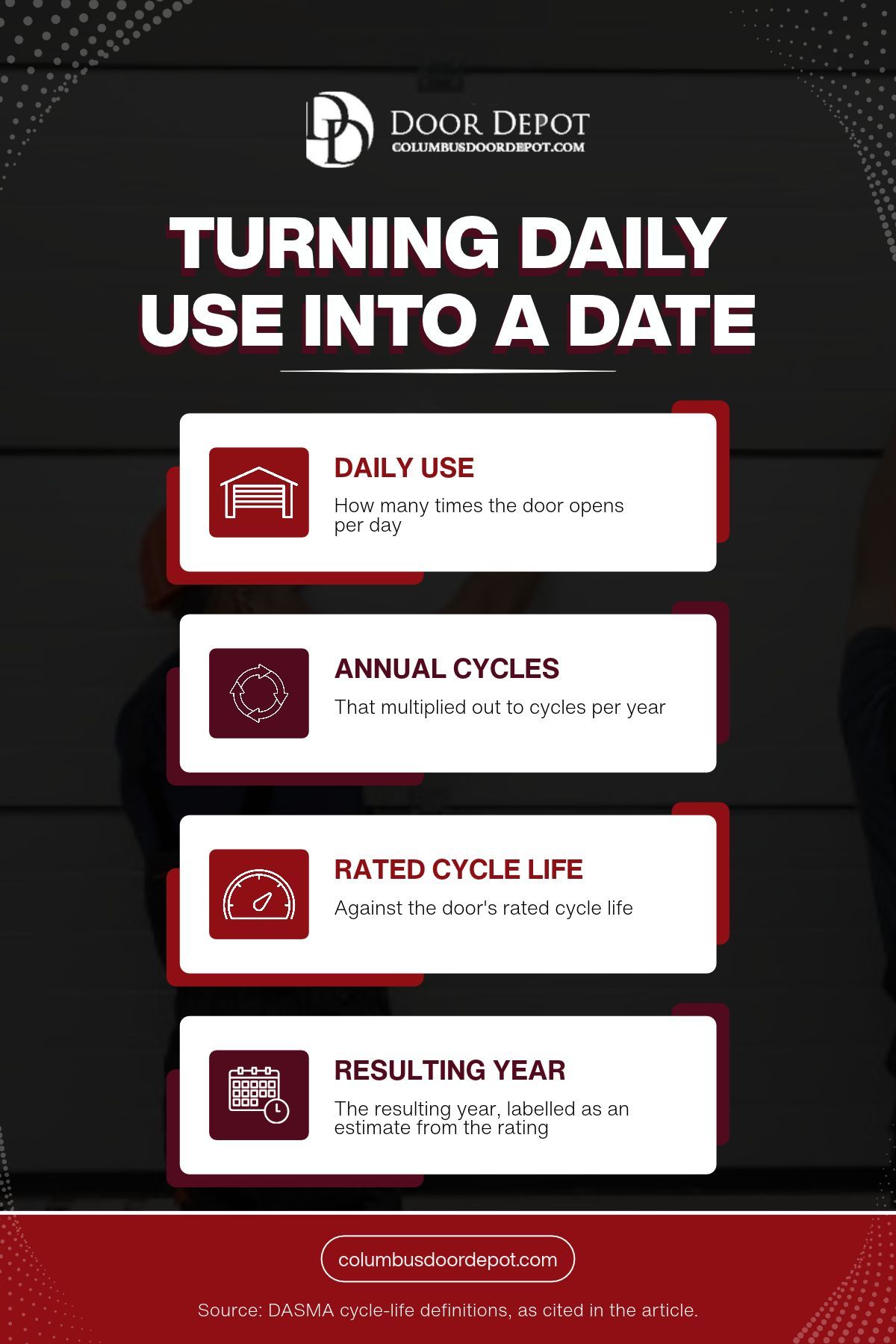
One cycle is one full open and close. A household that opens the door four times a day runs roughly 1,460 cycles a year, and one that uses it as the main entrance can double that without anybody thinking about it.
That is the number worth doing before any quote is compared, because it converts an abstract rating into a date.
The Three Ohio-Specific Reasons to Replace
Ohio does two things to a garage door that a milder climate does not, and both appear in the industry's own list of factors that shorten life.
Corrosion, which road salt accelerates
The association's technical guidance on spring cycle life is direct about rust. It states that springs should be kept dry to prevent surface rust, that rust reduces the effective area of spring wire, and therefore its overall strength, and that rust can cause corrosion pits from which fatigue cracks accelerate and reduce cycle life. It is set out in DASMA's technical data sheet on factors affecting spring cycle life.
Now add a central Ohio winter. Salt-laden slush comes off the car and sits on the garage floor, and the moisture and chloride it carries go into the air of a closed, unheated space. The same guidance notes that doors in climates subject to extreme heat or cold and frequent precipitation should be kept closed where possible, and it names corrosive chemicals containing chlorine as a cause of spring corrosion leading to premature failure.
Corroded springs on a door of a certain age are the clearest replacement signal there is, because the corrosion is telling you about the environment the whole assembly has lived in, not just about two springs.
The weight the door was never specified for
This one surprises people, and it is worth checking before any quote.
The same guidance warns that actions taken by building occupants, such as applying paint to the door or adding components to it, may cause the door weight to surpass the manufacturer's specifications. Where paint is suspected of affecting weight, it says a trained technician may measure the effect with a scale once the counterbalance system has been disabled.
A repainted door is common on older Ohio houses. Several coats of exterior paint on a large panel is real weight, and a counterbalance sized for the original door is now working against a heavier one for every cycle of its life. That shows up as springs that keep failing early, which reads as bad luck and is actually a specification problem.
An opener that predates the safety rules
The federal safety standard for automatic residential garage door operators is 16 CFR Part 1211, administered by the Consumer Product Safety Commission and dating in the Federal Register to December 1992.
It requires secondary entrapment protection, and it names what that can consist of. For a vertically moving door, the options include an external photoelectric sensor that reverses a closing door, returns it to the fully open position, and prevents the operator from closing an open door; an external edge sensor on the door edge with the same effect; a built-in door sensor operating independently of the primary protection system; or another device providing equivalent protection. The text is in Part 1211 of Title 16 of the Code of Federal Regulations.
If your opener has no photo-eyes near the floor on either side of the opening, you are looking at equipment from a different regulatory era. That is a replacement conversation regardless of whether the door itself is sound, and it is the one item on this page we would not describe as optional.
When Repair Is Clearly the Right Call
Having spent three sections on replacement, the honest position is that most calls are repairs and should be.
A single failed component on a door with no corrosion, no added weight, and a modern opener is a repair. Broken springs on an otherwise sound assembly, a snapped cable, worn rollers, a failed opener on a good door, damaged bottom weatherstrip, a bent track section: all of these are ordinary parts reaching the end of an ordinary life.
| Points toward repair | Points toward replacement |
|---|---|
| One component failed, the rest is sound | Repeated failures across different components |
| No visible corrosion on springs or hardware | Rust pitting on springs, cables, or track |
| Door weight matches its specification | Repainted or with items attached to the panelse |
| Opener has working photo-eyes | Opener with no secondary entrapment protection |
| Panels straight and undamaged | Impact damage across multiple sections |
The pattern in the right column is worth naming. Each of those rows is the same door reporting the same underlying condition through a different component. Two spring failures in three years on a door that has never been repainted is a different story from two spring failures on a door that has.
Our notes on common garage door problems and safety in Columbus go through the individual faults and cover the most common single failure.
What Maintenance Actually Buys, and What It Does Not
The rated life of a door assumes it is being looked after, which is a detail buried in how the standard is written.
The cycle life test permits lubrication during the run, and permits fasteners to be re-tightened, but neither more often than once every 1,500 cycles. That is a modest allowance, and it tells you two things. Maintenance is assumed in the rating rather than being an optional extra on top of it. And the amount assumed is small, which means a door that is greased twice a year is not being pampered; it is being kept to the condition the rating was measured under.
The association's guidance adds that regular greasing or lubrication of springs, as required in the manufacturer's instructions, helps maximise spring cycle life, and that the counterbalance assembly should be maintained according to the manufacturer's written instructions.
What that does not do is reverse anything. Lubrication slows wear on components that are still sound. It does not restore wire that corrosion has already pitted, and it does not re-size a counterbalance for a door that has gained weight. A maintenance visit on a door in good condition is genuinely worth booking. The same visit on a corroded assembly buys a little time and no more, and it is worth being told which of the two you have.
The one thing worth doing yourself
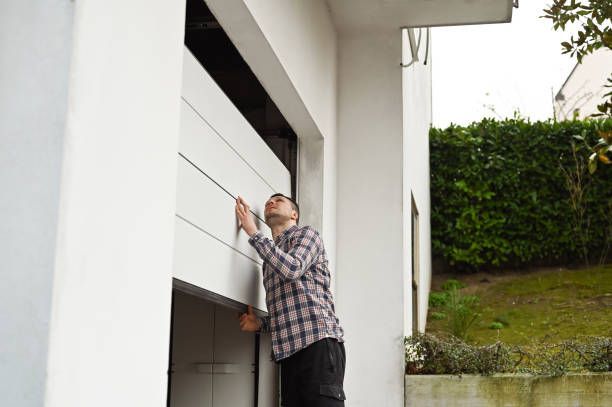
Watch the door go up and down, from outside, once a season.
A door that hesitates, that sounds different on one side, that drifts down from the open position, or that judders at a particular point on the track is reporting something. Drifting down in particular points at the counterbalance, which is where the weight question and the spring question both live.
None of that requires tools, and none of it requires touching a spring, which is not homeowner work under any circumstances.
Two Doors on the Same Street
A worked example makes the framework easier to apply than any checklist.
Two attached garages on the same Columbus street, both fitted around the same time. The first door has been repainted twice, sits above a drive that gets salted heavily every winter, and has had springs replaced twice in four years. The second has its original finish, a garage that stays closed through the winter, and one spring failure in the same period.
Both owners are now looking at a broken spring and a similar quote. The framework gives them different answers.
For the first door, the springs are not the story. Corrosion has been reducing the wire's effective strength, the added paint has been loading a counterbalance sized for a lighter door, and the two effects compound each other. A third spring replacement is buying time on an assembly that is telling you, repeatedly, what condition it is in.
For the second, a spring reaching the end of its cycle life on an otherwise sound door is exactly what is supposed to happen. Replace it, service the assembly, and expect years.
Same trade, same fault, same quote, opposite answers. The difference is not the part that broke. It is everything around it, which is the whole reason an assessment matters more than a price.
What a Good Assessment Should Include
If somebody is quoting you, these are the things that should have been looked at before a number was produced.
- The springs, for corrosion rather than just for breakage. Pitting matters more than surface discolouration
- Whether the door has been painted or modified since installation, and whether anybody has weighed it
- The opener's entrapment protection, meaning working photo-eyes correctly positioned and aligned
- The track, rollers and hinges as a set, because wear distributes across them
- Any history of repeated repairs, which is the strongest single predictor on this list
A quote produced without any of that gives you a price for a part while leaving your actual question unanswered. If you are weighing up who to call, our guide to vetting a garage door company in Columbus covers what to ask.
The Cost Comparison Nobody Frames Properly
The instinct is to compare the repair quote against the replacement quote and pick the smaller number. That comparison is missing a term.
The right comparison is the repair cost against the replacement cost divided by the years each buys. A repair that costs a fifth of a replacement and buys two years on a corroded, repainted door is not the cheaper option. A repair that costs a fifth and buys another decade on a sound door obviously is.
That is why the assessment above matters more than the quote. Without it, you are comparing a known number against an unknown duration, which is not a comparison at all.
Where the answer is replacement, our buying guide for Columbus sets out what actually differs between doors, and what a new garage door costs in Columbus covers the pricing side.
Have the Door Assessed Before the Quote Is Compared
The decision turns on the condition of the whole assembly, not on the price of the broken part, and that takes somebody looking at it properly. Columbus Door Depot handles garage door repair across central Ohio, and we would rather tell you a door has years left than sell you a replacement it does not need.
Frequently Asked Questions
How long should a garage door last?
There is no single number, because the industry rates doors in cycles rather than years. One cycle is a full open and close, so a household's own usage converts a cycle rating into a realistic date.
Does a broken spring mean I need a new door?
Usually not. A broken spring on an otherwise sound door is an ordinary repair. Corroded springs, or springs failing repeatedly, are a different signal and point to the condition of the whole assembly.
Why do my springs keep breaking?
Two common causes are corrosion, which the industry describes as reducing the effective area of the spring wire and its strength, and door weight exceeding the manufacturer's specification after painting or added components.
Is my old opener unsafe?
If it has no photo-eyes near the floor on either side of the opening, it predates the secondary entrapment protection requirements in the federal safety standard for residential garage door operators. That is worth replacing on its own terms.
Does road salt really affect a garage door?
The industry guidance names chlorine-containing chemicals as a cause of spring corrosion leading to premature failure, and identifies moisture and climate extremes as factors that shorten spring life. An Ohio garage in February has both.