
Reading the Blinking Light on a Garage Door Opener
TL;DR
A garage door opener that blinks is reporting a diagnostic code rather than failing at random. On Chamberlain and LiftMaster units, the two overhead light bulbs flashing ten times means the safety reversing sensors are blocked, misaligned, or unpowered, and the door will not close from a remote until the beam is restored.
The same brands also flash a two-digit code on the UP and DOWN arrows on the motor housing: count the UP flashes, pause, count the DOWN flashes, then look the pair up. Genie units count once on a single status LED, one through eight.
Sensor faults and wiring faults are homeowner-fixable. Board, travel-module, and door-binding codes are not.
What the Blinking Light Is Actually Telling You
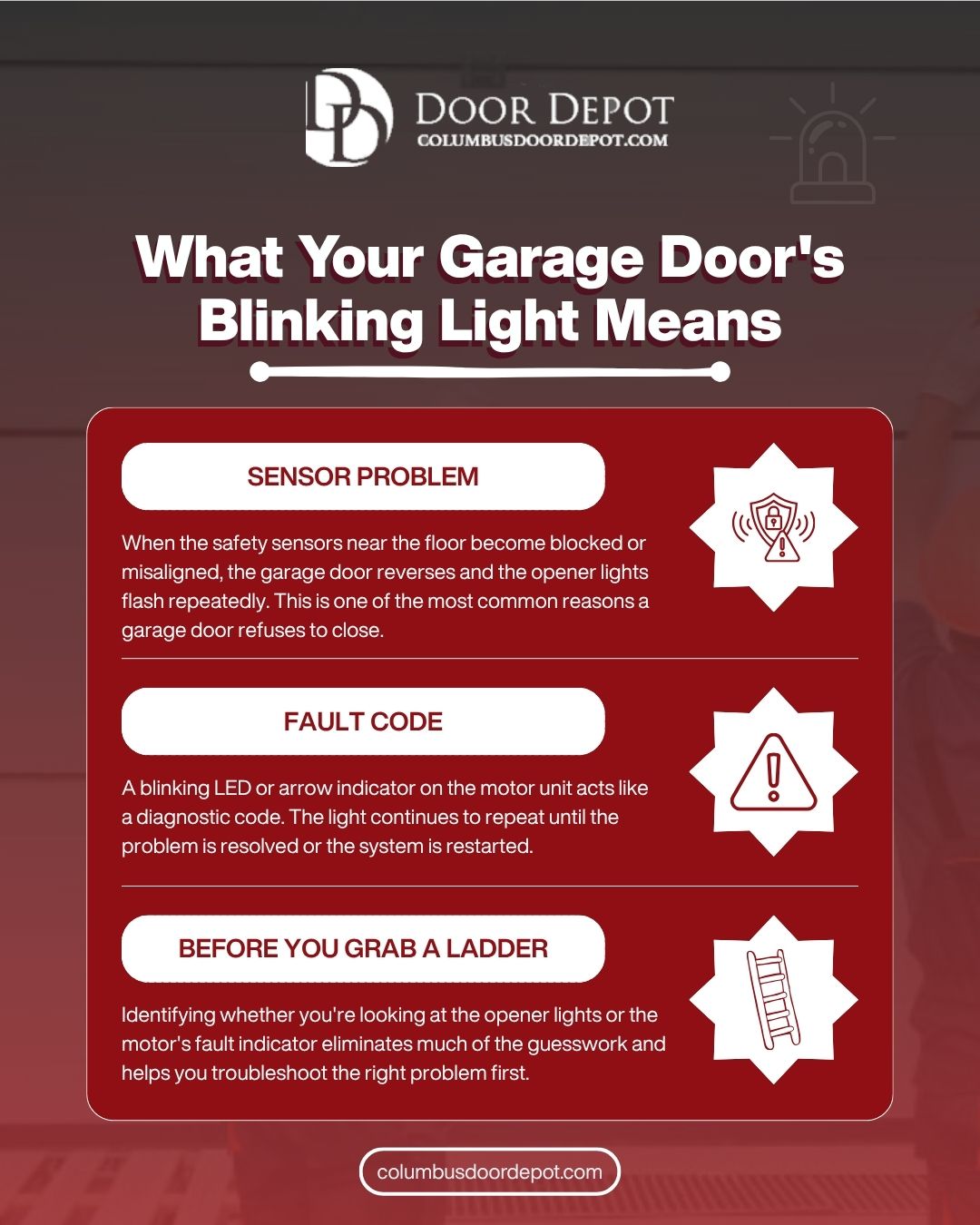
Two different signals get called "blinking," and they mean different things.
The first is the pair of light bulbs in the motor housing. Take a Chamberlain belt drive: when the invisible beam between the two floor-level sensors is broken or misaligned while the door is closing, the door reverses to fully open, and the opener lights flash ten times. That behaviour is written into the owner's manual for the unit, and it is the single most common reason a door refuses to close on an otherwise healthy opener.
The second is a small LED, or a pair of arrows, on the motor unit itself. That is the fault code. It repeats in a loop until the condition clears or power is cycled, and it is the closest thing a garage door has to a check-engine readout.
Knowing which of the two you are looking at cuts the guesswork roughly in half before anyone touches a ladder.
Why Does the Opener Flash Ten Times and Refuse to Close?
Ten flashes of the overhead bulbs mean the safety reversing sensors are not seeing each other. The two small eyes bolted near the bottom of the vertical track are a through-beam pair: one sends an invisible beam, the other receives it. Break that beam while the door is travelling down, and the opener stops the door and sends it back up. If the beam is already broken when you press the button, the door will not start down at all.
The fix is almost always aim, power, or dirt, in that order.
On Chamberlain and LiftMaster hardware, the sending sensor carries an amber LED, and the receiving sensor carries a green one. Both should glow steadily. A flickering green LED means the pair is close but not quite aimed at each other, and the wing nuts on the brackets loosen enough to nudge them true by hand. An amber LED that is dark points upstream at power or a broken wire rather than at aim.
The sunlight problem nobody warns you about
Chamberlain's own installation instructions say that if the receiving sensor sits in direct sunlight, you swap it with the sending sensor so the receiver ends up on the opposite side of the door. Low sun pouring straight into a receiving eye can wash out the beam it is trying to read. In central Ohio, that bites hardest on west-facing garages in late afternoon and on east-facing ones just after sunrise, which is exactly when most people are leaving or arriving.
If your door closes fine at noon and balks at six in the evening, start there before you buy parts.
How high the eyes are allowed to sit
Height is not a matter of preference. The Door and Access Systems Manufacturers Association sets it in Technical Data Sheet #364: the photoelectric beam must be emitted no higher than six inches above the garage floor, and the sensors should sit within six inches of the door's path.
The U.S. Consumer Product Safety Commission puts the working range at four to six inches in its garage door safety publication. Anything mounted higher can miss a child lying on the floor, which is the whole reason the device exists.
We find eyes zip-tied halfway up the track more often than we would like, usually because someone got tired of the door reversing on a stack of firewood.
Chamberlain and LiftMaster Count in Two Numbers
Look at the back or side of the motor unit for two arrow-shaped indicators. The opener flashes the UP arrow, pauses, then flashes the DOWN arrow. Those two counts are the code. The table below is the chart published with these units, verified against the Chamberlain owner's manual 114A5036B and the
Chamberlain Group diagnostic code reference.
| UP flashes | DOWN flashes | What the opener found |
|---|---|---|
| 1 | 1 | Safety sensors not installed or connected, or a wire is cut |
| 1 | 2 | Short or reversed wire on the safety sensors |
| 1 | 3 | Door control wires shorted, or the wall control is faulty |
| 1 | 4 | Safety sensors misaligned or momentarily obstructed |
| 1 | 5 | Door binding or obstructed: broken spring, engaged door lock, travel module |
| 1 | 6 | Door coasts past its stop; travel needs reprogramming, or the door needs balancing |
| 2 | 1 to 5 | No movement and no sound; logic board replacement |
| 3 | 2 | Cannot set or hold travel; travel module |
| 3 | 3 | Battery backup charging circuit error; logic board |
| 4 | 1 to 4 | Door moving, then stopping or reversing; binding or sticking |
| 4 | 5 | Communication error to the travel module |
| 4 | 6 | Safety sensors misaligned or momentarily obstructed |
Notice how much of that first column is wiring. Sensor wire runs get stapled to the jamb during construction, and a staple driven a millimetre too deep will short the pair years later, which reads as 1-2 rather than 1-1. Mice chew the same wire in October when the weather turns.
One detail catches people out on newer units. These openers drop into a sleep mode when the door is fully closed, and the sensor LEDs go dark along with the overhead bulbs. Dark sensor LEDs on a closed door are normal. Judge the LEDs with the door open.
Genie Counts Differently, and the Beams Have Their Own Code
Genie does not use two numbers. The Excelerator series flashes a single status LED under the lens cover, and the count runs from one through eight. Genie publishes the list for models H8000, ISD990, ISD995, ISD1000, PRO99, and CMD9900 in its own Excelerator self-diagnostic guide.
| Blinks | What Genie says it means |
|---|---|
| 1 | Motor drive board interrupt |
| 2 | Controller board interrupt |
| 3 | Opener overheated or over-cycled |
| 4 | Force settings incorrect |
| 5 | Safe-T-Beam malfunction |
| 6 | Wall console not working |
| 7 | Limit switches not working |
| 8 | Wall console locked |
Eight is the happy ending. That is the vacation lock left on by whoever cleaned the garage, and it takes a second to undo at the wall console.
Genie's beams then run a second diagnostic of their own, published as the Safe-T-Beam troubleshooting chart on the same Genie support site.
| Safe-T-Beam LEDs | What Genie says it means |
|---|---|
| Red source steady, green receiver steady | Normal operation |
| 2 red blinks | Beams off aim, obstructed, or a defective sensor |
| 3 red blinks | Receiver is picking up interference |
| 4 red blinks | Dave |
Interference is the interesting one. It sends people hunting for a broken part when the actual culprit is often something new and bright pointed at the eye.
What Does It Mean When Nothing Blinks at All?
A completely dark opener is a power problem until proven otherwise. Garage circuits in older Clintonville and Bexley homes frequently share a GFCI with an exterior outlet, so a wet receptacle on the patio can kill the ceiling unit without tripping anything in the panel. Check the GFCI reset before the breaker.
Work down this order:
- Press the hardwired wall button. If the wall button runs the door and the remote does not, the opener is fine, and the remote is the suspect.
- Look for the lock icon on the wall console. Vacation lock disables every remote and keypad while leaving the wall button live, and it gets bumped constantly.
- Check whether the emergency release rope has been pulled. The trolley disconnects, the motor runs, and the door sits there. Re-engaging it takes one cycle.
- Replace the remote's coin cell. Chamberlain rates the CR2032 in its visor remotes for up to three years, and a dead cell means the remote's own LED will not flash when you press the button.
One more that surprises homeowners: bulbs. The Chamberlain manual for this generation of opener specifies an A19 incandescent up to 100W or a 26W compact fluorescent, and it says plainly not to use LED bulbs, because they may reduce the range or performance of your remote controls. If your remote suddenly only works from ten feet away and someone recently swapped the bulbs, that is your answer.
Central Ohio Weather Writes Codes of Its Own
Two seasons produce most of the diagnostic calls we take, and they produce different codes.
August is the overheat season. Columbus averages a normal high of 84.16 degrees for the month at John Glenn International, per the National Weather Service climate normals for 1991 to 2020, and an uninsulated attached garage in Westerville or Lewis Center sits well above the outdoor air by late afternoon. Genie's code 3 exists for exactly this: overheated or over-cycled; wait ten minutes, do not unplug. Households with teenage drivers and three cars hit the thermal cutout more than anyone else, and the door usually works again by dinner, which is why the call never gets made until it happens twice.
Winter flips the failure mode. January normals for Columbus, from the same National Weather Service dataset, run 37.19 for the high and 21.97 for the low with 9.5 inches of snow across the month.
Cold thickens the grease in the track and stiffens the bottom seal onto the slab; the door needs more force to move, and a healthy opener reads that resistance as an obstruction. A Chamberlain unit surfaces that as 4-1 through 4-4: door moves, then stops or reverses.
Replacing a spring or forcing the travel settings up is the wrong response. The door has genuinely got heavier to move, and the fix is at the door.
Cold matters at the standards level too. When the CPSC reviewed the ANSI/CAN/UL 325 revisions in its 2023 staff memorandum on residential garage door operators, it recommended folding in a requirement that edge sensors intended for outdoor temperature exposure must actuate at 40 lbf or less when tested at minus 31 degrees Fahrenheit. Ohio does not reach that, but the rule exists because sensing hardware genuinely behaves differently when it is cold.
Two Tests Every Homeowner Should Run Each Month
Both tests take under two minutes, and both are named in the manufacturer's instructions, not invented by us.
The reversal test comes from CPSC, in the same publication cited above.
- With the door open, lay a 2x4 flat on the floor in the door's path.
- Close the door. It should strike the wood, stop, and reverse.
- A door that does not reverse should be disengaged from the opener until it is adjusted, repaired, or replaced.
Chamberlain's manual sets the same bar using a one and a half inch object, and CPSC asks homeowners to inspect the door and the opener every 30 days.
The beam test comes from DASMA. Start the door moving down, then put a controlled obstruction through the beam; a cardboard box works. The door must reverse direction and return to fully open. DASMA calls for this monthly on residential and commercial units alike.
There is a reason both bodies keep repeating it. CPSC reports that about 73 children between two and fourteen were trapped and killed under automatic garage doors between March 1982 and the publication of its safety alert, roughly three a year, with others left with brain damage or serious injury when a door failed to stop and reverse.
Reversing systems became mandatory on units manufactured or imported after January 1, 1991, and the external entrapment protection requirement followed in 1993.
Codes That Mean Stop Pressing the Button
Some codes are an invitation to a screwdriver. Others are a warning.
Anything reporting binding, coasting, or a door that stops partway is telling you the problem is the door, not the opener. Behind those codes sits a spring under enormous tension, and a broken torsion spring is the most common thing we find after a 1-5. That is not homeowner work. If the door will not lift by hand with the trolley disconnected, or lifts and then slams, stop and get garage door spring service in Columbus, Ohio, booked instead of cycling the opener again.
Logic board codes are the other stop sign. A 2-1 through 2-5, a 3-3, or a Genie 1 or 2 are internal electronics, and swapping a board on a fifteen-year-old chain drive is often worse value than replacing the unit. That is the honest conversation to have before parts get ordered, and it is the one we have on most garage door opener repair Columbus calls where the opener predates smartphone control.
Sensors that read correctly and still refuse to let the door close are the third case. If both LEDs glow steadily, the eyes sit under six inches, nothing crosses the beam, and the opener still flashes ten times, the fault is upstream in the wiring or the board. At that point, you want same-day garage door repair rather than another hour on the ladder. We cover Delaware and Lewis Center on the Delaware service route and the north suburbs from the Westerville route, and a sensor or wiring call is usually a single visit.
Getting the Opener Light Back to Steady
Write the code down before you do anything else. Count the flashes twice, note whether it was the overhead bulbs or the arrows, and check both sensor LEDs with the door open rather than closed.
That one minute of observation tells you which job this is: cleaning a lens, chasing a staple through a wire run, or looking at a spring. Most Columbus, Westerville, Delaware, and Lewis Center homeowners who call us already know which category they are in by the time we pick up, and the visit goes faster for it.
If the code points past the sensors, or the door will not move by hand, Columbus Door Depot can get a technician out and put the light back to steady.
Frequently Asked Questions
Why is my garage door opener not working even though the motor runs?
The trolley has been disconnected by the emergency release rope. The motor spins, but the carriage does not grab the door. Pull the rope back toward the opener until it latches, then run one full cycle to re-engage.
What does it mean when my garage door opener blinks ten times?
Ten flashes of the overhead bulbs on a Chamberlain or LiftMaster unit means the safety reversing sensors are blocked, misaligned, or unpowered. The door will reverse or refuse to close until both sensor LEDs glow steadily with nothing crossing the beam.
How high should garage door safety sensors be mounted?
DASMA specifies the photoelectric beam be emitted no higher than six inches above the garage floor, within six inches of the door's path. CPSC puts the working height at four to six inches. Higher mounting can miss a child lying down.
Can I reset a garage door opener myself?
Unplugging the unit for thirty seconds clears many transient faults and is safe to try. Holding the yellow programming button on the motor unit erases the memory, which also clears the fault, but it wipes every remote, keypad, and vehicle button, so reprogram them afterward.
Does a blinking opener always mean an expensive repair?
No. A sensor knocked off aim, a dirty lens, a bumped vacation lock, and a dead remote battery account for a large share of blinking codes and cost nothing to fix. Board, spring, and travel-module codes are the expensive ones.