
How Many Times a Day Does Your Garage Door Open? Probably More Than You Think
Nobody asks how old their tires are. They ask how many miles are on them.
Your garage door works the same way, though it's rarely talked about that way. It doesn't wear out because it turned seven. It wears out from how many times it's gone up and down, which is why two houses on the same street can be years apart.
And once school starts, it goes up and down a lot more than you'd guess. There's the morning run and the trip back. Somebody heading out to work. A kid letting themselves in after the bus. Practice, then the drive home. One more run because a cleat got left behind.
That's an ordinary Tuesday, and it's already ten times before dinner. Saturday is worse.
Ten a day is a lot for a garage door. It's also completely normal this time of year, which is why doors tend to give out in the fall rather than the middle of July.
Door Depot has been fixing garage doors in central Ohio since 1993. Here's what all that use does to a door, in plain terms, and what you can do about it before it turns into a bad morning.
What This Guide Covers
- Why your door wears out by use instead of by age
- How to count your own daily number in about a minute
- Why fall is when doors start acting up
- What goes first, and what it sounds like
- What it's like when a spring actually goes
- A thirty-second test you can do yourself
- Whether to fix it or replace the whole door
- What fall clutter in the garage does to the door
- What you can safely do yourself between visits
- The gap at the bottom, and what gets in through it
- What to check if you just moved in
- What winter is about to ask of it
- What happens when the power goes out
- Kids and a door that's always moving
- What actually happens during a tune-up
- If you run a business, the number is much bigger
- What to have ready when you call
- Frequently asked questions
Your Door Has Mileage on It
A double garage door weighs somewhere between 130 and 350 pounds. It's the heaviest thing in your house that moves, and you ask it to move several times a day, every day, in whatever weather Ohio is having.
The parts that make that happen wear out based on how many times they've done it, not how long they've been sitting there. The springs above your door, the ones doing the lifting, are typically built for about 10,000 trips up and down. In the trade, one trip is called a cycle, which is why you'll sometimes hear a technician talk about cycles.
Ten thousand sounds like a lot until you divide it up.
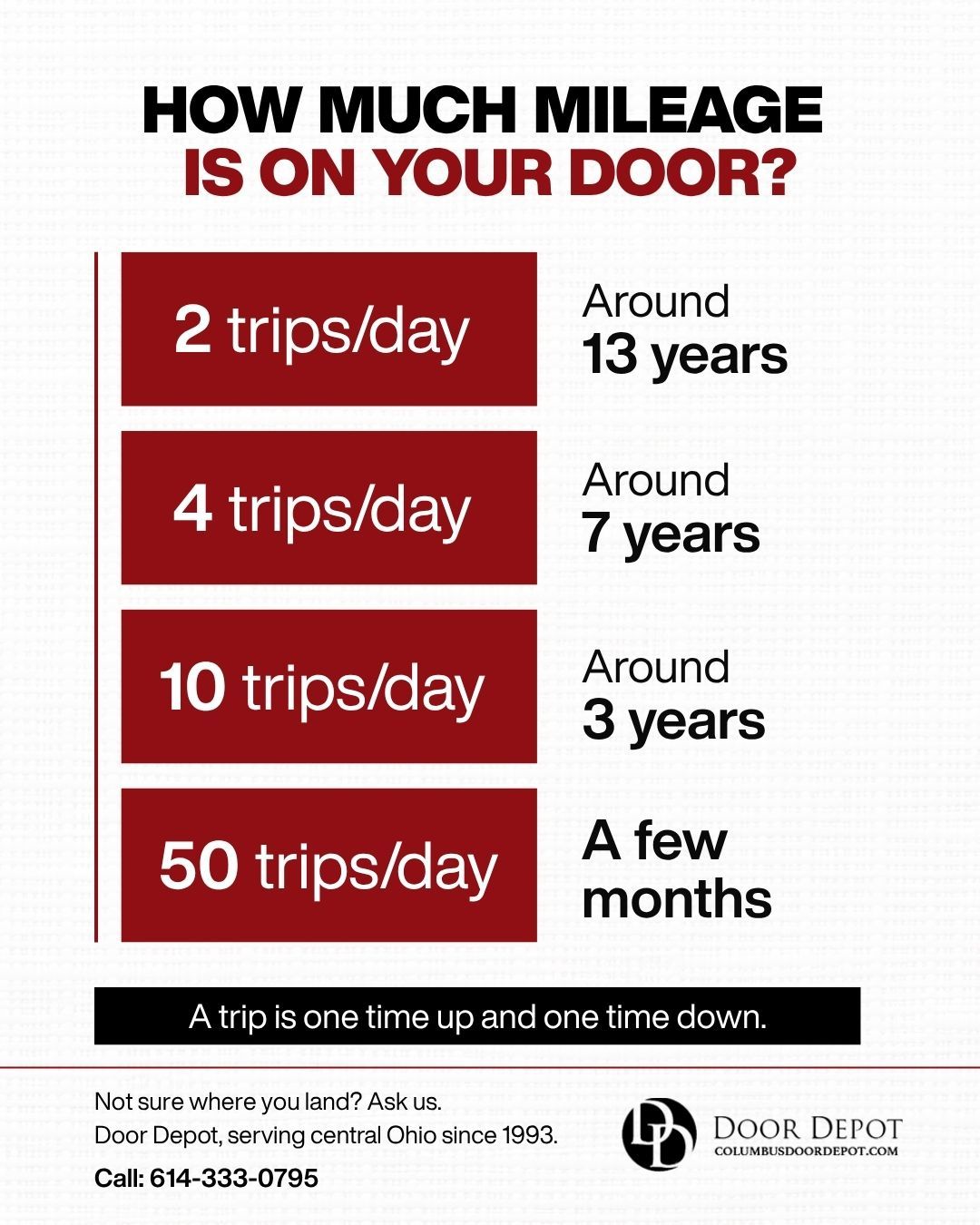
- Four trips a day works out to somewhere around seven years.
- Ten trips a day is under three.
- Fifteen or more, which is a normal school year for a family with a couple of kids in activities, and you're looking at closer to two.
So your door is as old as your habits, not as old as your house. A retired couple down the street can have the same door as you, installed the same week, and still be years away from needing anything.
Work Out Your Own Number
This takes about a minute, and the number is usually higher than people guess.
Count trips, not people. Leaving is one, coming home is another. Two cars out in the morning and back at night is four right there. Then add the run to the store, the practice drop-off, the trip back for the cleat somebody forgot, and going out through the garage to walk the dog.
- Two adults working, no kids at home: about 4 to 6 a day.
- One parent home with school-age kids: about 8 to 12 during the school year.
- Two working parents plus after-school activities: 10 to 16 is normal through the fall.
- If the garage also holds the bikes, the mower, and the trash cans, add a few more for the trips that have nothing to do with a car.
If you have a two-car door and a separate single, count them separately. One of them is the door everybody uses, and the other one holds the lawn equipment, so they rarely wear out together. It's common for one to need work while the door three feet away is fine.
Why Fall Is When Doors Start Acting Up
Summer is loose. School's out, the schedule softens, and a lot of days are one trip out and one trip back.
Then September arrives, and everything tightens up. Same door, two or three times the use, and now it's happening in colder air. Grease that was thin in August gets stiff by November, which means everything has to work a little harder on every trip.
None of that breaks a door on its own. It just uses the door up faster than the calendar suggests, which is why service calls climb every fall and again after the first hard freeze.
What Wears Out, and in What Order
Parts don't all wear out at the same rate. There's a rough order to it, and knowing the order tells you what you're listening for.
The noisy stuff shows up first. The little wheels that run the door up the track wear down and start rattling. Hinges dry out and squeak. Neither one stops the door, which is exactly why people live with it for a year without doing anything about it.
The springs are what end the conversation. They sit above the door, and they carry its weight, and when one breaks, the door is far too heavy to lift by hand. That's the phone call we get at seven in the morning.
The opener sits in between, and it's worth knowing what it's actually for. The springs hold the weight. The opener only guides the door up and down. So when the springs start to weaken, the opener quietly takes over work it was never built to do, and it does that on every single trip. That's why a lot of openers quit years earlier than they should have.
So catch it at the noisy stage, and you're looking at a greasing and maybe a new set of wheels. Catch it at the spring stage, and you're looking at a morning you didn't plan for.
What It's Like When a Spring Actually Goes
Worth knowing what you're in for, because it's the one failure that turns into an emergency rather than an errand.
You'll usually hear it before you see it. A broken spring makes a loud bang, often in the middle of the night, and plenty of people think something fell over in the garage. The next morning you press the button and one of two things happens. Either the door doesn't move at all, or it lifts a few inches, groans, and stops.
Either way, your car is in there, and you're not going anywhere. It's never a convenient morning.
The thing to avoid is the instinct to help it. Grabbing the bottom of the door and pulling while somebody presses the button is how people get hurt, and it's how a bad door becomes a bent door. Without the spring, you're lifting the full weight, which on a double door can be well over two hundred pounds, and it can come down faster than you can get out of the way.
What to do instead is simple. Leave it closed, don't keep pressing the button, and call. If you absolutely have to get a car out, it takes two people, and it takes somebody holding the door the entire time, and we'd still rather you waited for us.
And this is why the small signs are worth paying attention to. A spring near the end of its life gives you weeks of hints. The bang is just the last one.
What a Tired Door Sounds Like
A door that's wearing out tells you well before it quits. The problem is that it happens slowly enough that a household just gets used to it.
- It's louder than it used to be. Not one bad noise, just louder in general.
- It hesitates for a second when it starts to lift, or the last foot down takes longer than it did.
- It looks a little crooked on the way up, with one side leading the other.
- It starts closing, changes its mind, and goes back up.
- You can see a line of daylight at the bottom corners when it's shut.
- There's a visible gap or break in one of the springs above the door, or a cable looks worn and stringy.
A broken spring or a frayed cable is the one to act on today. Everything else on that list can wait for a scheduled visit. But once a spring goes, the rest of the door is holding weight it was never built to hold on its own.
The Thirty-Second Test You Can Do Yourself
Here's a check anyone can do, and it needs no tools.
With the door closed, pull the red cord hanging from the rail. That disconnects the door from the opener. Now lift the door by hand to about waist height and let go.
A healthy door stays roughly where you put it. If it slides down or springs upward, the springs aren't carrying the weight properly anymore, and your opener has been picking up the slack every time you press the button.
When you're done, close the door and run the opener until you hear it click back onto the rail. And if lifting the door is a real struggle in the first place, stop there and call us. That weight is the warning.
Do I Fix It or Replace the Whole Thing?
This is the question we get asked in the driveway more than any other, and the honest answer is that it's usually a repair.
Doors are built to be serviced. Springs, wheels, cables, and openers are all parts you replace on a door you keep, and none of them means the door itself is finished. A door with a lot of miles on it and good panels is worth fixing, and that stays true for a long time.
What actually pushes the conversation toward a new door is the door itself, not the parts on it.
- Panels that are dented, cracked, or rusting through along the bottom.
- A door that's been hit by a car, which usually bends more than it looks like it did.
- A wood door that's soaked up years of weather and gotten heavy and soft.
- A garage that's freezing all winter because the door has no insulation in it at all.
- A door you've already put several repairs into over a couple of years.
And sometimes the reason is just that you're tired of looking at it. That's a fine reason. A new door changes the front of a house more than almost anything else you can spend the same money on.
What we won't do is turn a spring call into a sales pitch. If a repair will hold, we'll say so, and we'll fix it.
Fall Fills the Garage
Bikes come in off the driveway. The mower gets pushed against the wall. A season of sports gear lands wherever there's room, and then the holiday bins come down and everything shifts again.
This causes a service call we take constantly, because the stuff people lean against a garage wall is the stuff that ends up leaning against the door.
- A bike or a stack of bins parked in front of the little sensor near the floor. The door refuses to close, and everyone assumes the sensor is broken.
- A ladder or a rake resting on the track. Weeks of light pressure are enough to pull it out of line.
- Boxes stacked against the door, so it can't sit down flat, and the opener thinks it's hit something.
- Something tall stored where the open door hangs, which the door then finds on the way down.
- A car parked far enough forward that the door clips the roof rack. Expensive lesson.
None of that is actually broken. All of it looks broken. When you finish rearranging the garage this fall, run the door up and down once and watch the whole trip. Ten seconds catches nearly all of it.
What You Can Do Yourself Between Visits
A few things genuinely help, and a couple of things make it worse. Here are both lists.
Start with what helps. None of it takes more than a few minutes.
- Wipe the tracks out with a rag. You're clearing grit, not greasing them, and the tracks are one of the few parts that should stay dry.
- Keep the two small sensors near the floor clean and pointed at each other. A cobweb or a bumped bracket is behind a lot of doors that won't close.
- Check the bottom rubber strip once a season for cracks and flat spots.
- Look at the cables on either side now and then. They should look like tidy cable, not like a frayed shoelace.
- Tighten any bolt you can see that's obviously loose in the brackets along the sides. Snug is enough.
Now the two we'd ask you not to do.
The first is spraying the wrong stuff on things. WD-40 is a solvent, so it thins out the grease that's supposed to be there and leaves the parts drier than it found them. It also runs down onto the track and picks up dirt. If you want to grease something yourself, a proper garage door lubricant on the hinges and wheels is the right idea, and a little goes a long way.
The second is the springs. The ones above your door are wound extremely tight, and adjusting them takes specific bars and specific training. This isn't a case of a professional protecting their turf. It's the one part of a garage door that genuinely hurts people every year, and there is no version of that job worth doing on a Saturday.
The Gap at the Bottom of the Door
There's a rubber strip along the bottom of your door that squashes flat against the floor when it closes. It's the only thing sealing that seam, and it takes a beating, because it spends its life pressed into concrete and sitting in whatever runs down the driveway.
When it goes hard and flat, you get a thin line of daylight at the closed door, usually starting at the corners. Leaves blow in. Cold air comes with them, which you notice fast if there's a bedroom over the garage. And in October, when everything outside is looking for somewhere warmer, a quarter-inch gap is an invitation to mice.
It's a small part and a quick fix. Worth checking the floor too, since concrete that's settled or cracked at the threshold can leave a gap no seal will close on its own. And if the bottom of the door is dented or rusting through, the honest conversation is about the door rather than the strip.
Here's how to check yours. Close the door on a bright afternoon, stand inside, and look along the bottom. If you can see light, you found it.
Just Moved In? You Inherited a Mystery
If you bought your house in the last year or two, here's a thing nobody tells you at closing: you have no idea how much life is left in that garage door.
A home inspection checks that the door works and that the safety features work. It doesn't tell you how many trips are on the springs, and the sellers almost certainly didn't know either. The door could be two years from needing anything or two months.
It's also worth knowing that the previous owners may have used it completely differently than you do. A retired couple who kept one car in there and drove twice a week leaves a door with plenty left. A family of five who used it as the main way in and out leaves the same door in a very different place, and it'll look identical from the driveway.
One visit sorts it out. Somebody looks at the springs and the cables, checks whether the door is still carrying its own weight, and tells you where you stand. Then you either budget for it or forget about it for five years. Either answer beats finding out on a Monday.
When the Power Goes Out
Ohio doesn't get through a fall without wind. And when the power goes out, an opener without a backup battery won't do anything at all.
You can still get the door up. That's what the red cord is for. Pull it and lift by hand, and only do that with the door already closed, because a heavy door can come down fast on you. Afterward, run the opener until it clicks back onto the rail.
If a spring is broken, this is different. Don't try it. The springs carry the weight, not the motor, and a door with a broken spring can be too heavy for one person to hold. That's a call, not a project.
A backup battery handles the ordinary version of this. It keeps the door working long enough to get a car out and shut it behind you. You'll only need it a few days a year, and those are the days you'll be glad it's there.
Kids and a Door That's Always Moving
In a house where the door runs a dozen times a day, kids get comfortable with it fast. Two things are quietly keeping that routine boring, and both are worth testing.
First, the two small sensors near the floor on either side of the opening. They watch across the doorway, and anything that interrupts them while the door is closing sends it back up. Test them by waving a broom through the gap as the door comes down. If it keeps going, stop using the door and call somebody.
Second, the door should back off on its own if it hits something solid. Lay a piece of scrap wood flat under the door and close it. The door should touch the wood and go straight back up.
One more thing worth saying plainly. The button on the wall should be mounted high enough that a small child can't reach it, and nobody should ever be ducking under a moving door. Every technician in this trade has a story about that. None of them are good ones.
What Winter Is About to Ask of It
Cold makes everything on a garage door a little less willing.
Grease gets thick, so the door moves slower and the opener works harder. Metal contracts slightly, so parts that were just barely fine in September get tighter. And the rubber strip along the bottom stiffens up, which is when a door starts freezing to the concrete after a wet night.
The freezing is worth a warning of its own, because the instinct is to keep hitting the button. Don't. When a door is frozen down and the opener keeps pulling, something has to give, and it's usually the cables or the bottom of the door. Break the ice loose first with warm water or a plastic scraper, then run it.
None of this is dramatic on a door that's in decent shape. It's rough on a door that was already tired in October, which is the whole reason fall is the right time to look at it rather than January.
What Actually Happens During a Tune-Up
It's a short visit, and it's the least dramatic thing on this list, which is exactly why it works on a door with a lot of miles on it.
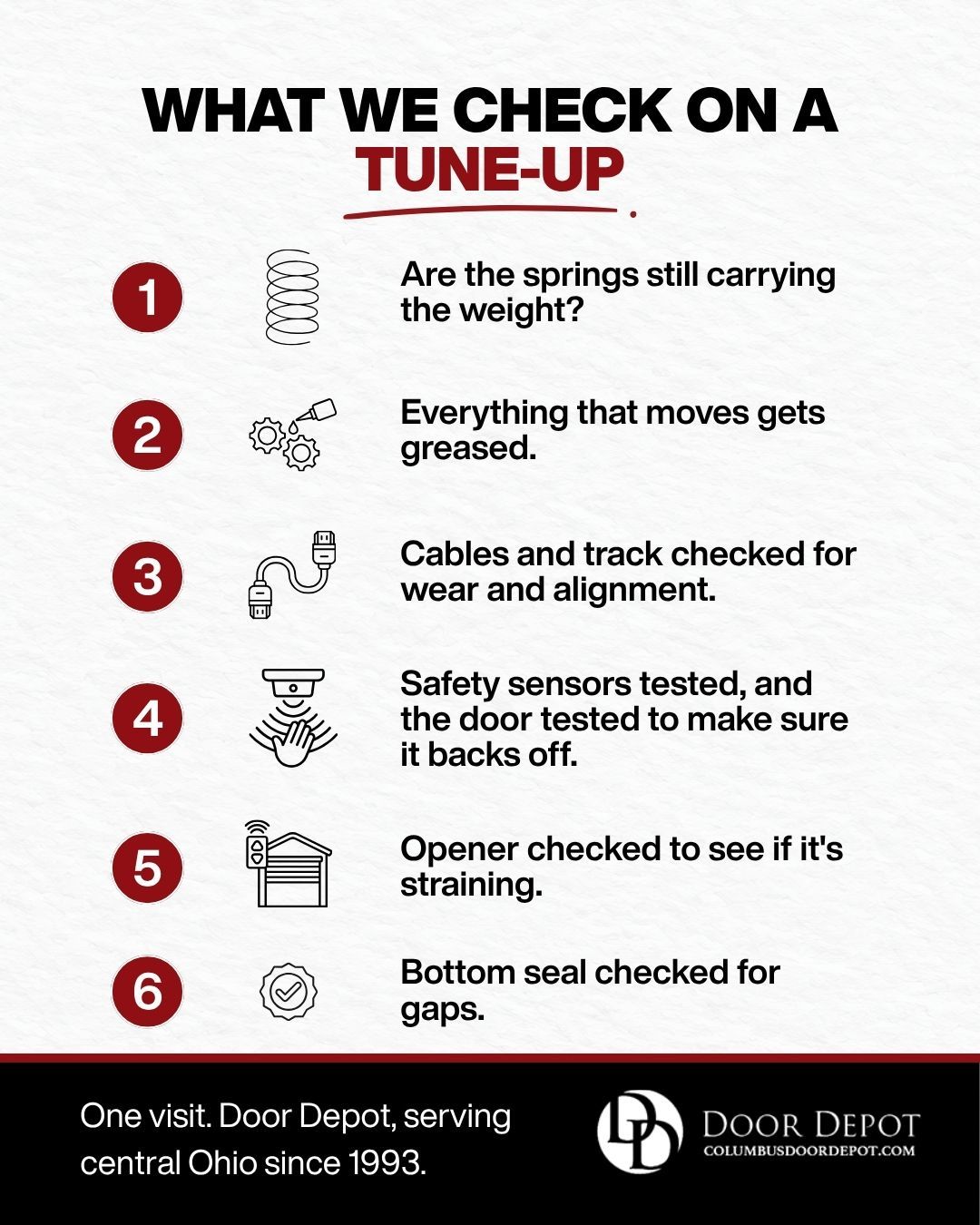
A technician greases everything that moves, checks whether the springs are still carrying the weight properly, looks over the cables and the track, tests the safety sensors, and runs the opener to see whether it's working harder than it should be. If something's starting to go, you find out while it's still a small job.
Once a year covers most households. If your door is running ten or more trips a day, it's worth a second look. And early fall is the right timing either way, so the door heads into the cold greased and adjusted instead of catching up in March after a rough winter.
If You Run a Business, the Number Is Much Bigger
Everything above is about a house. Take the same idea to a shop or a warehouse and the numbers change completely.
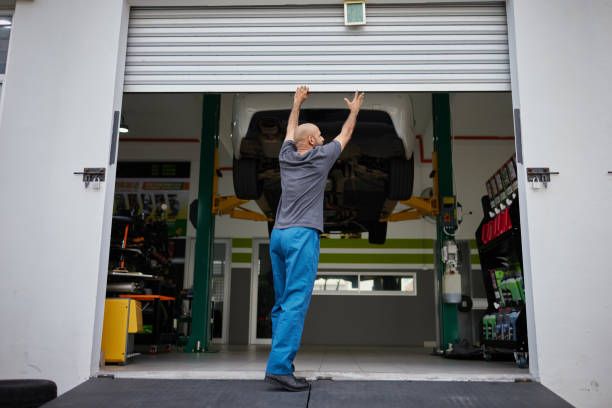
A busy service bay can run fifty trips a day. A loading dock door can run several hundred. At that rate, the same springs that last a family seven years are finished in a couple of months, which is why doors built for businesses are built differently in the first place.
The cost of ignoring it is also different. A door down for three hours at a shop isn't three hours of one person's time. It's every technician whose bay is stuck behind it, every customer whose car is inside it, and a day's appointments pushed into a day that was already full. At a dock, it's a driver waiting and a delivery window gone.
If you want a quick sense of where you stand, count one busy door for a single shift and multiply it out for the week. The number is usually bigger than anyone in the room expects, and that number is what your door should have been built for.
Why the Cheap Door Costs More
Doors made for businesses use heavier springs, sturdier track, and motors built to run all day. That's the whole difference, and it's the reason the cheaper option ends up costing more within three years.
The conversation that gets it right is a boring one. How many times a day does this open, how heavy is what goes through it, and is anything about this building governed by code? Those answers decide what you should be installing, and getting them right up front is the difference between a door that's part of the building and a door that's part of your week.
Which Businesses Call Us
Commercial garage door work covers more kinds of buildings than the phrase suggests, and plenty of owners don't realize they're in that category until something stops moving.
- Auto shops and dealerships, where a stuck bay door means a car trapped on a lift.
- Warehouses and distribution buildings, where one failed dock door reroutes a whole afternoon.
- Self-storage facilities, with dozens of small roll-up doors that fail one at a time and are rarely on anyone's maintenance list.
- Contractors and landscapers with a yard and a shop, where the door is often the oldest thing on the property.
- Restaurants, breweries, and retail with a back delivery bay, where the door is small, ignored, and the only way anything gets in.
- Churches, schools, and municipal buildings, where the budget cycle means it has to be right the first time.
The calls sound about the same either way. A door off its track after somebody backed into it. A motor that finally quit after fifteen years.
Springs at the end of their run. A door that won't seal at the bottom and is costing a fortune to heat. And in the fall, a manager looking at the fourth quarter and deciding they'd rather handle it on a Tuesday morning than the Friday before a shipping deadline.
Getting Serviced Without Shutting Down
Business doors get ignored because there's never a convenient hour to take a bay offline.
Which is the argument for scheduling one, since a planned visit takes a fraction of the time an emergency does and it happens when you choose. We can usually work around a shift, come in before you open, or take whatever window your operation actually has.
For the times it isn't planned, our emergency crews are available around the clock, and same-day service is available throughout the Columbus area with a response that typically runs two to four hours depending on where you are and what time it is.
What to Have Ready When You Call
None of this is required, and you'll get help either way, but a few details up front usually make the visit shorter.
- Roughly how many times a day the door runs. It's the most useful thing you can tell us.
- How old the door and the opener are, even if the answer is that they came with the house.
- What it's doing, in your own words. "It groans and stops halfway" beats a diagnosis every time.
- Whether it's one door or two, and whether both are acting up.
- If you can see a broken spring or a cable hanging loose, mention it. That changes what goes on the truck.
What to Expect When You Call Door Depot
We're family-owned, and we've been doing this in Columbus since 1993, long enough that a fair number of the doors we service are ones we installed. Our technicians are licensed, insured, and certified, and we work with LiftMaster, Linear, and Amarr.
You tell us what the door is doing. We come look at it, tell you honestly what we find, and give you options instead of one recommendation. If a repair will hold, we'll say so. If something is near the end and replacing it now saves you a second trip in February, we'll say that too, and it's your call.
The Communities We Serve
Door Depot works throughout Columbus and the surrounding communities in central Ohio.
- Columbus and the east side, including our home base near Westbourne Avenue
- Dublin, Hilliard, and Worthington
- Westerville, Gahanna, and Lewis Center
- Delaware and Grove City
If you're just outside that list, call and ask. We cover more ground than the map suggests.
Find Out Where Your Door Stands
Count your trips this week. If the number is higher than you expected, that's useful to know, because everything on this list is easier and cheaper to handle before something breaks than after.
Whether it's a tune-up on a door that's been working overtime, springs that are near the end, or a business door that needs to be built for what you actually put it through, it's the same local team.
Frequently Asked Questions
How many times a day does the average garage door open?
About four trips a day for a typical household, counting each time it goes up and back down. Families with school-age kids and after-school activities are usually running eight to sixteen, and that difference is what decides how long the door lasts.
How long do garage door springs last?
It depends on use rather than age. They're built for about 10,000 trips, so four a day is roughly seven years and ten a day is under three. Door Depot can tell you what's in your door and whether a heavier-duty set is worth it.
Why is my garage door suddenly so loud?
Usually, it's the rollers or dried-out hinges, and it shows up sooner on a door that runs a lot. It's normally a greasing and maybe a new set of rollers if you catch it early, which is what our tune-up is for.
How often should a garage door be serviced?
Once a year for most homes, and early fall is a good time so the door heads into the cold already greased and adjusted. A door running ten or more trips a day, and any door at a business, is worth looking at more often.
How do I know if something's wrong with my garage door springs?
Close the door, pull the red cord to disconnect it from the opener, lift it to waist height by hand, and let go. It should stay put. If it drops or rises on its own, the springs need attention, and until they get it, your opener is doing their job for them.
Will my garage door open if the power goes out?
Only if your opener has a backup battery. Otherwise, you'll pull the red cord and lift it by hand, which you should only do with the door closed. If a spring is broken, don't try it at all. The door will be much heavier than you expect.
My garage door won't close, and the light is blinking. What's wrong?
Almost always, it's the two small sensors near the floor. Something's in front of one, or they've been bumped out of line. Clear the area and check that both are pointing at each other. If it still won't close, give us a call.
Should I repair my garage door or replace it?
Usually repair. Springs, wheels, cables, and openers are all parts you replace on a door you keep. What pushes it toward a new door is the door itself: dented or rusting panels, damage from a car, or a garage that's freezing all winter because there's no insulation in it. We'll tell you which one you're looking at.
Can I spray WD-40 on my garage door?
Better not to. It's a solvent, so it thins out the grease that's supposed to be there and leaves things drier than it found them, and it drips onto the track and collects dirt. A proper garage door lubricant on the hinges and wheels is the right idea. The tracks themselves should stay dry, just wiped clean.
Do you offer same-day and emergency service?
Yes. Same-day service is available throughout the Columbus area, with a response time that typically runs two to four hours depending on your location and the time of day, and our emergency crews are available around the clock.