
Why Is Your Garage So Much Colder Than the Rest of the House?
Your garage is colder than the rest of your house, and it isn't because the heat can't reach it.
It's the door.
A standard two-car garage door is about a hundred and twelve square feet. That's the biggest single surface on the front of your house, bigger than any window you have, and on a lot of houses it's the only one with nothing inside it. Just a sheet of steel between your garage and whatever the weather is doing.
Once you know that, a few things stop being mysteries: why the garage never gets comfortable, why the bedroom over it always runs cold, and why the car is covered in frost even though it was parked inside.
The good news is that this is one of the more fixable problems in a house, and the first fixes are small ones. Door Depot has been working on garage doors in central Ohio since 1993, and this is the time of year the phone starts ringing about it.
What This Guide Covers
- It's the Door, Not the Walls
- How Cold Does a Garage Actually Get?
- Why There's Frost on a Car That Was Parked Inside
- Why the Room Above the Garage Is Always the Cold One
- What the Garage Is Doing for the Rest of the House
- Where the Cold Actually Gets In
- The Door From the Garage Into the House
- The Small Fixes Worth Doing First
- How to Tell Whether Your Door Has Anything In It
- A Word on Condensation
- Attached, Detached, and What Changes
- What an Insulated Door Actually Changes
- About Those Insulation Kits
- Is a Heater in the Garage Worth It?
- What It Won't Fix
- What the Cold Does to What You Keep Out There
- If You Actually Use the Garage
- What About Windows in the Door?
- What Changes the Week After
- Getting It Done Before the Holidays
- Heating a Shop With a Door That Opens All Day
- If Your Garage Has Never Been Warm
- What a Visit Looks Like
- The Communities We Serve
- Final Thought
- Frequently Asked Questions
It's the Door, Not the Walls
The walls of an attached garage are usually built like the rest of the house. Studs, insulation, drywall, or at least sheathing. They're doing their job.
The door isn't built that way, and it was never meant to be. It has to be light enough for a motor to lift and thin enough to bend around a curved track and stack against the ceiling. A basic door solves those problems with a single layer of steel and nothing behind it.
So you end up with a wall of the house that performs like a storm door. That's fine in April. In January it's the difference between a garage you can stand in and one you hurry through.
Insulated doors solve this by building a layer of foam into each panel, sandwiched between steel. Same size, same track, same opening. The difference is what's inside it, and you feel that difference the first cold morning.
How Cold Does a Garage Actually Get?
An attached garage with an uninsulated door usually sits somewhere between the outdoor temperature and the indoor one, and it drifts much closer to outdoors than people expect.
On a twenty-degree Columbus morning, a garage like that is often in the thirties. It's warmer than the driveway because it's sheltered and because it borrows a little heat from the house, but it isn't close to comfortable, and it isn't warm enough to keep frost off a windshield.
Put an insulated door on the same garage and the floor of that range comes up noticeably. Nobody should promise you a heated room, but what you do get is a space that holds onto warmth instead of giving it away, which is the whole point.
Why There's Frost on a Car That Was Parked Inside
This one bothers people more than it should, and it's a good illustration of what's going on.
Frost forms on your windshield when the glass drops below freezing and there's moisture in the air to settle on it. A garage keeps rain and snow off the car, and it blocks the wind, but if the space itself is sitting in the thirties overnight, the glass gets just as cold as it would outside. The roof over it doesn't change that.
What does change it is a garage that holds a few more degrees. Keep the space above freezing and the windshield stays clear, which is the difference between leaving on time and standing in the driveway with a scraper.
It's a small thing, and it's also the first thing people notice after the door gets handled, because it happens every single morning.
Why the Room Above the Garage Is Always the Cold One
This is the complaint we hear more than any other version of this problem, and it catches people off guard because the room itself seems fine. It has the same windows and the same vents as everywhere else, and it's still always four or five degrees behind.
The reason is underneath it. Every other room in your house sits on top of either a heated room or an insulated floor over a crawlspace or basement. The bonus room over the garage sits on top of an unheated box, and that box is only as warm as the biggest, thinnest wall in it.
Warm the garage up and that floor stops being the coldest surface in the room. A lot of people who were about to call an HVAC company about an airflow problem turn out to have a garage door problem instead.
What the Garage Is Doing for the Rest of the House
An attached garage shares at least one wall with the house, and often a ceiling too. Whatever temperature that garage settles at, the rooms touching it have to work against.
Think about which rooms those are. Usually a kitchen, a laundry room, a mudroom, or a bedroom above. Those are the rooms people complain about, and the complaint is almost always the same: that one room never gets comfortable and the thermostat doesn't seem to help.
A warmer garage turns a cold neighbor into a mild one. The furnace stops fighting a thirty-degree wall and the room next door finally sits where the rest of the house sits.
That's the part worth understanding. Handling the garage door isn't only about the garage. It's about everything the garage touches.
Where the Cold Actually Gets In
Here's the part that surprises people. On a lot of garages, more cold comes in around the edges of the door than through the door itself.
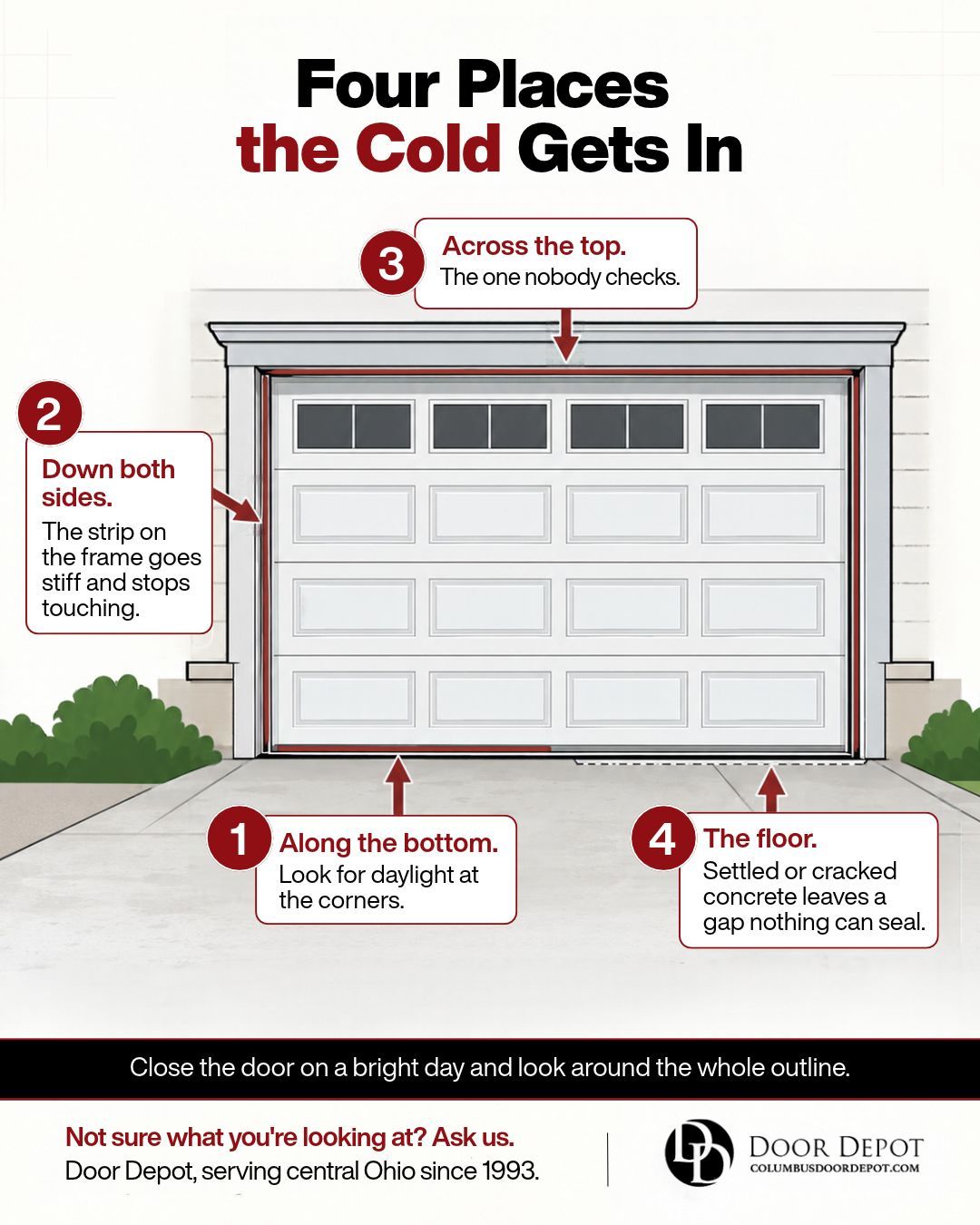
There are four places to look, and you can check all of them in about two minutes on a bright day with the door closed.
- Along the bottom. The rubber strip under the door should squash flat against the concrete. If you see a line of daylight, especially at the corners, that's the biggest gap you've got.
- Up both sides. There's a strip of weather stripping running down the door frame on each side. It goes stiff and shrinks over the years and stops touching the door.
- Across the top. Same idea as the sides, and it's the one nobody ever looks at.
- The floor itself. Concrete settles and cracks at the threshold, and no rubber strip can seal against a surface that isn't flat anymore.
Stand inside with the door shut and look around the whole outline. Anywhere you can see light, air is moving. On a windy night you can usually feel it with the back of your hand.
The Door From the Garage Into the House
One more opening worth two minutes of your attention, because it sits between a cold space and a warm one.
The door from the garage into your kitchen or mudroom is an exterior door in every way that matters, even though it feels like an interior one. It's the barrier between a thirty-degree garage and your living space, and it's often the most neglected door in the house.
Check it the same way. Close it, and look for light around the frame and underneath. Run your hand around the edge on a cold day. If the weather stripping is flattened or the sweep along the bottom is worn down, that's a draft going straight into the room you're paying to heat.
Handling that one is usually a hardware-store afternoon, and we'd tell you that rather than sell you something. But it's worth doing in the same week you deal with the garage door, because the two problems feed each other.
The Small Fixes Worth Doing First
We'd rather do the cheap thing first and have it work than sell you a door you didn't need yet. In a lot of cases the edges are the whole problem.
A new bottom strip and fresh weather stripping around the frame is a short visit, and on a door with good panels it can change how the garage feels immediately. It's the sort of job where people call back surprised at the difference.
Worth doing at the same time: the service door, the regular walk-in door between the garage and the yard if you have one. It's small enough to overlook, and it leaks just like anything else with a worn seal.
If the edges are already tight and the garage is still cold, then the door itself is what's left, and that's a different conversation.
How to Tell Whether Your Door Has Anything In It
You can answer this yourself in about ten seconds, and it tells you a lot about what to do next.
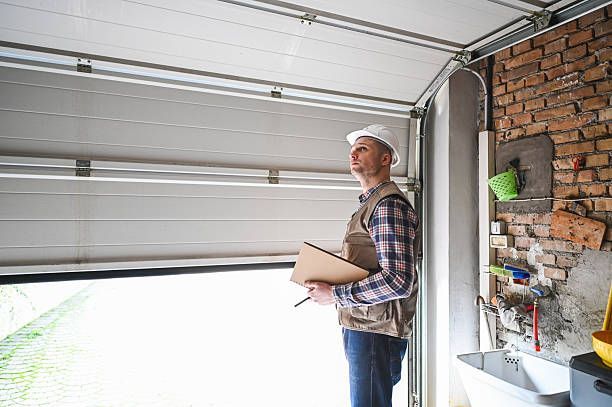
Go into the garage and look at the inside face of the closed door.
- If you can see the bare back of the steel panels with horizontal braces running across them, there's nothing in it. That's a single-layer door, and it's the most common one on builder-grade homes.
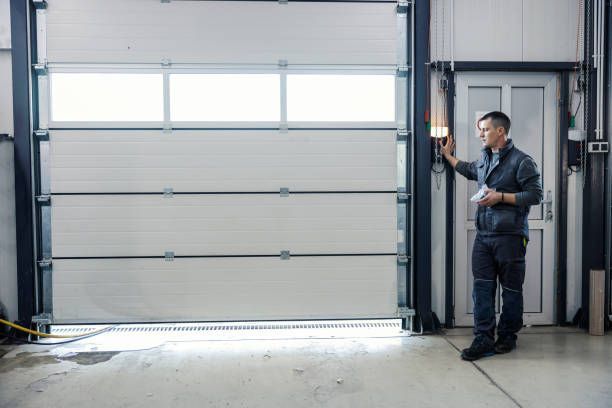
- If the inside is covered by a smooth second surface, or you can see a layer of foam or a vinyl backing behind the braces, there's insulation in there.
- Knock on it: a single-layer door rings hollow, while an insulated one thuds.
- Lift it by hand with the door disconnected from the opener. An insulated door is heavier, which is also why the springs on it have to be matched to it.
If your door turns out to be insulated and the garage is still cold, that points you straight back at the edges, and that's a much smaller job.
If it's a single layer and the garage is somewhere you actually spend time, you now know what the ceiling on improvement is. Sealing the edges will help. It won't change what the door itself is.
A Word on Condensation
Cold metal and damp air don't get along, and a garage in winter gives you both.
When warm, humid air meets a surface that's near freezing, it leaves water behind. In a garage that surface is usually the inside of the door. You see it as beads or a damp film on the panels, and the knock-on effects show up elsewhere: tools spotting with rust, cardboard boxes going soft at the bottom, and the musty smell people blame on the floor.
A snow-covered car melting in a closed garage adds a lot of water to that air, which is why it tends to be worse right after a storm.
An insulated door helps because the inside face never gets as cold, so there's far less for the moisture to condense on. Cracking the door for a few minutes after you pull a wet car in helps too, and costs nothing.
Attached, Detached, and What Changes
The advice shifts a little depending on which one you have, so it's worth being clear.
With an attached garage, the door is doing double duty. It affects the garage and it affects every room sharing a wall or a floor with it. That's the setup where handling the door pays off twice, and where people notice it in rooms they weren't even thinking about.
With a detached garage, there's no shared wall, so the benefit stays in the garage. That's still worth it if you use the space for anything beyond parking, and it's still worth it for the car, the stored goods, and the condensation. It's just an honest difference, and we'd rather say so than pretend otherwise.
One more thing on detached garages. They're often older, and the opening itself may have shifted over the years, so the seals have more to close. A look at the frame is usually part of the answer there.
What an Insulated Door Actually Changes
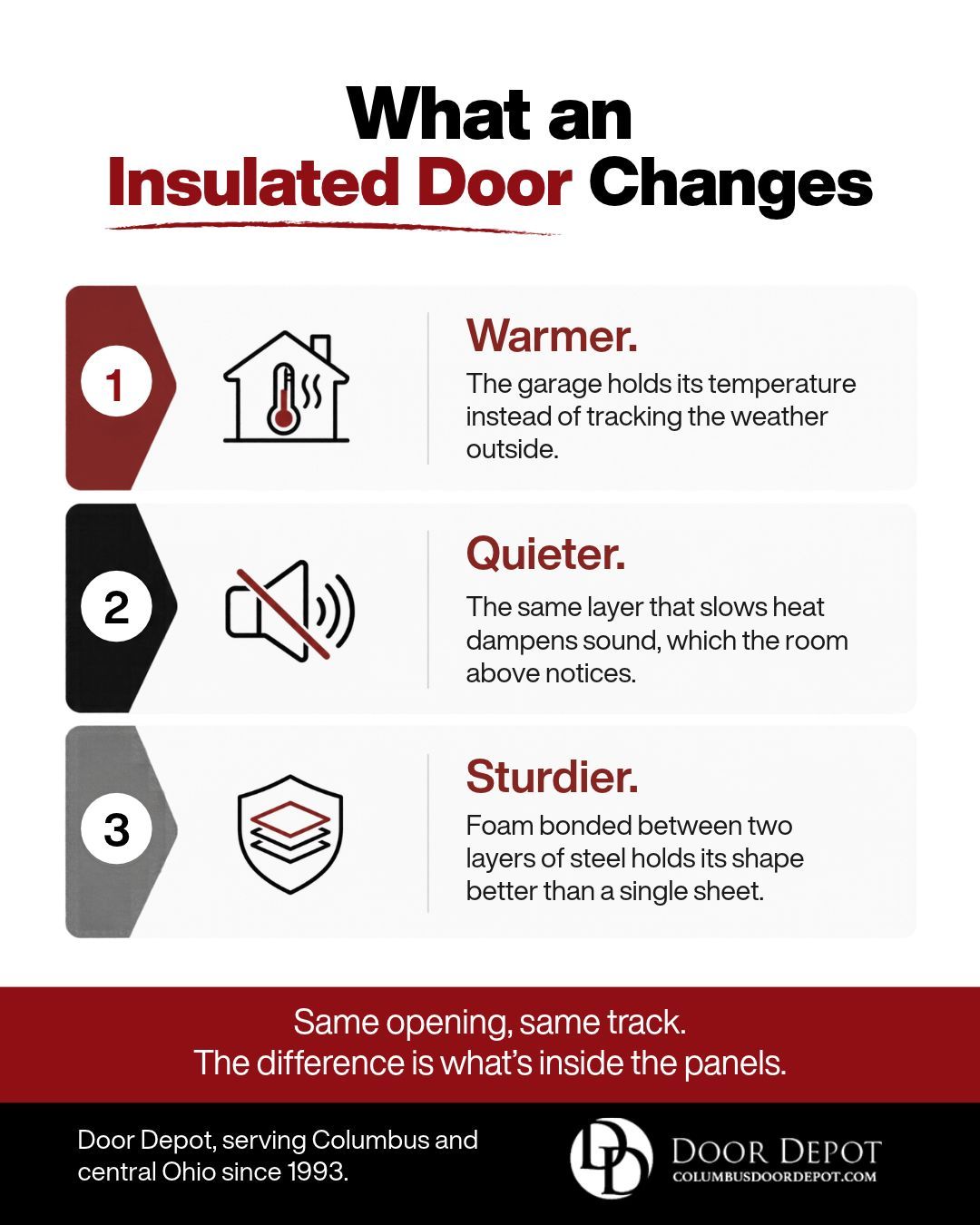
Three things, and only one of them is the one people expect.
The garage holds its temperature. That's the obvious one. It stays meaningfully warmer in winter and cooler in summer, and the rooms that touch the garage get easier to heat and cool as a result.
It's quieter. This one surprises people. The foam inside the panels dampens sound the same way it slows heat, so the door runs quieter and the garage gets less of the street. If there's a bedroom above it, that's the benefit people mention first after the fact.
It's sturdier. A panel with foam bonded between two layers of steel is simply stiffer than a single sheet. It handles a stray basketball better and it holds its shape longer.
You don't have to take the whole house into account to decide. If your garage is attached, if anything above or beside it is a room you use, or if you spend any time out there in winter, an insulated door earns its keep.
About Those Insulation Kits
If you've searched this before, you've seen the kits. Foam boards or batts you cut to size and press into the back of each panel. They're inexpensive and the idea is sound, so it's worth saying clearly what they do and don't do.
They will make the door warmer. That part is real, and for a detached garage you use occasionally, a kit can be a reasonable call.
Here's the part the box doesn't mention. Your door is balanced. The springs above it are matched to the weight of that specific door, and that balance is what lets the door hold itself in place and lets the opener do its job without straining. Add twenty or thirty pounds of foam and the springs are now sized for a door that doesn't exist anymore.
What that looks like in practice: the door gets heavy at the bottom of its travel, it drifts down when it should hold, and the opener starts working noticeably harder on every trip. Over a winter that adds up.
None of that means don't do it. It means if you do, have the springs adjusted to the new weight afterward, which is a short visit. And know that a kit is still foam pressed against a single sheet of steel, with the frame of the door and the edges unchanged. A door built with insulation inside it is a different thing, and it doesn't put your springs out of balance to get there.
Is a Heater in the Garage Worth It?
People ask this a lot, and the honest answer is that it depends what you fix first.
A heater in a garage with an uninsulated door and open gaps around the edges is working against an open window. It'll run constantly, it'll cost you, and the space still won't hold warmth once the heater is off.
Tighten the edges and put an insulated door on the same garage, and a modest heater suddenly makes sense, because now there's something to hold the heat in. Plenty of people find they don't need the heater at all once the door is handled.
So the order matters. Seal it, insulate it, then decide whether you still want to heat it.
What It Won't Fix
Worth being straight about the limits, because overpromising helps nobody and you'll find out anyway.
An insulated door won't turn an unheated garage into a room you'd sit in with a book in January. It narrows the gap rather than closing it.
It also won't do much for you if the rest of the garage is wide open. If the ceiling has no insulation above it, or the walls to the outside were never finished, the door can only do its share. That's not a reason to skip the door, since it's the biggest surface and usually the worst one, but it's worth knowing what else is in play.
And it won't fix a service door with a worn seal, a cracked window, or a gap where the framing meets the slab. Those are separate and usually small.
What it does, reliably, is take the single largest and thinnest surface on your house and make it behave like the rest of the building. On most garages that's the majority of the problem, and it's the part you can solve in a morning.
What the Cold Does to What You Keep Out There
A garage that swings with the outdoor temperature is rough on more than your hands.
- Car batteries lose cranking power as they get cold. A battery that starts the car fine at fifty degrees can struggle at ten.
- Paint, caulk and adhesives are usually ruined by freezing, and the damage isn't always obvious until you open the can in spring.
- Canned food and anything in glass can freeze and split.
- Tire pressure drops as it gets colder, which is why the dashboard light comes on during the first cold snap.
- Anything with water in it, including a utility sink or a line running through the garage to an outdoor spigot, is at risk in a space that gets down to freezing.
None of that is a reason to panic. It's just a reasonable list of things that get easier when the space stops tracking the outdoor temperature so closely.
If You Actually Use the Garage
A lot of garages in central Ohio stopped being just somewhere to park years ago. There's a bench and a set of tools, or a rack and a treadmill, or a second fridge and a chest freezer.
Those are the garages where the door matters most, because they're the ones people want to use in January and quietly give up on in November.
A gym out there tends to lose to the cold sometime in December, because the temperature is what ends the habit rather than the motivation. A workshop runs into a firmer limit, since glue and finish won't cure properly below a certain point and your hands stop being useful well before that. And a fridge or freezer sitting in a space that swings forty degrees is working harder than it needs to all winter.
Handling the door is what makes those spaces usable year-round, and it's a smaller project than finishing out a room.
What About Windows in the Door?
People like them, and they ask whether they're a mistake in a cold garage.
Short version: a row of windows is a small part of a large door, so it's not the thing deciding whether your garage is cold. If natural light would make the space better, that's a reasonable thing to want.
Worth knowing anyway. Glass doesn't hold heat the way an insulated panel does, so a door with windows gives up a little more than one without. There are insulated glass options that narrow that difference, and the windows usually sit in the top section, which is the part of the door farthest from where you stand.
If the garage is a workshop or a gym, the light is often worth the trade. If the garage is strictly for parking and you want every degree, skip them. Either answer is fine, and it's the sort of thing worth talking through rather than deciding from a brochure.
What Changes the Week After
A fair question before spending money on something you can't see working.
The first thing people notice is the sound. The door runs quieter, and if there's a bedroom above the garage, the early departure stops announcing itself to the whole house.
The second is the windshield. Clear glass on a morning when the neighbors are scraping.
The third takes a week or two, and it's the one that matters most. The room next to the garage, or the one above it, stops being the cold room. People tend to mention that one last because they weren't expecting it, and it's usually what makes the whole thing feel worth it.
The fourth is the garage itself, and it depends what you do out there. If it's parking, you'll notice you don't rush through it. If it's a gym or a shop, you'll notice you keep using it past November.
Getting It Done Before the Holidays
Two practical notes on timing, because this is the stretch where it matters.
First, seals and doors both go in faster when it isn't an emergency. A planned visit takes a fraction of the time a broken-door call does, and it happens on a morning you picked.
Second, if you're hosting, the garage is about to get busier. Extra cars in the driveway, coolers and folding chairs moving through, people coming in that way because the front walk is full. A door that's been borderline all fall tends to pick that week to act up.
If it's on the list, this is the stretch to get it off the list.
Heating a Shop With a Door That Opens All Day
Everything above applies to a house. For a business the math is the same and the numbers are bigger.
If you heat a shop, a warehouse, or a service bay, the overhead door is the largest opening in the building and it spends part of every day wide open. Every one of those openings dumps the heat you paid for and pulls cold air in behind it.
A few things move the needle, and they're worth looking at together rather than one at a time.
- Insulated doors, for the same reason they work at a house, scaled up to a much larger surface.
- Seals that are actually doing their job. On a commercial door the perimeter seals and the dock seals take a beating, and worn ones are a constant draw on the heating bill.
- How long the door stands open. A door that closes promptly loses far less than one propped open through a shift, and on high-traffic openings there are doors built to cycle faster for exactly this reason.
- Snow and ice at the opening. Piled snow at the threshold keeps a door from seating, which turns a closed door into an open one.
The buildings that feel this most are predictable. Auto shops and service centers, where a bay door goes up for every vehicle in and out. Warehouses and distribution buildings, where dock doors stand open through a shift. Contractors and landscapers with a heated shop they actually work in. Self-storage facilities, where the heated units are only as good as the doors on them.
If your heating bill climbs every winter and nobody can say why, the doors are worth a look before anything else in the building. Our commercial crews are available around the clock, and we can usually schedule around a shift so a bay isn't down during working hours.
If Your Garage Has Never Been Warm
Plenty of houses in central Ohio have been standing a long time, and in an older house the assumption is usually that a cold garage is just part of the deal.
Sometimes the door is simply old and has nothing in it, which is straightforward. But in an older garage there's often a second thing going on, and it's worth naming.
Buildings settle. Over decades, an opening can go slightly out of square, the slab can shift, and the frame can move. When that happens, a seal that would close a straight gap is being asked to close a tapered one, and it can't. That's why some garages stay drafty even after someone has already replaced the weather stripping once.
The fix depends on what we find. Often it's a different profile of seal that can close an uneven gap, and sometimes it means correcting the frame itself. Occasionally the opening needs work before a new door goes in, and we'd want you to know that up front rather than on the day.
The point is that an old cold garage usually isn't a lost cause. It's a slightly different problem than a new one, and it's still a problem with an answer.
What a Visit Looks Like
You tell us the garage is cold and roughly where you think it's coming from. We come look.
A technician checks the seal along the bottom and around the frame, looks at whether the floor is still flat enough to seal against, checks what the door itself is made of, and tells you what's actually causing it.
Sometimes that answer is a strip of rubber and an hour. Sometimes it's a new door. We'll tell you which one you're looking at and let you decide, and if the cheaper fix will do the job, that's what we'll recommend.
We're family-owned, we've been doing this in Columbus since 1993, and our technicians are licensed, insured, and certified. If you want to see the range of door options first, our garage door installation page walks through them.
The Communities We Serve
Door Depot works throughout Columbus and the surrounding communities in central Ohio.
- Columbus and the east side, including our home base near Westbourne Avenue
- Dublin, Hilliard, and Worthington
- Westerville, Gahanna, and Lewis Center
- Delaware and Grove City
If you're just outside that list, call and ask. We cover more ground than the map suggests.
Final Thought
A cold garage feels like something you just live with, which is why so many people do. It isn't. It's one surface on your house behaving differently from all the others, and it's a surface we work on every day.
Start by closing the door on a bright afternoon and looking around the outline for daylight. Whatever you find, there's a fix, and the first one is usually smaller than you'd guess.
When you're ready, call Door Depot at (614) 888-9733 or request a free estimate at columbusdoordepot.com.
Temperature and comfort descriptions are general guidance. Results vary by garage size, construction, what the door is made of, and how well the opening is sealed.
Frequently Asked Questions
Why is my garage so much colder than the rest of my house?
Almost always the door. A two-car garage door is about a hundred and twelve square feet, the largest surface on the front of the house, and a basic one is a single layer of steel with nothing inside it. Door Depot can tell you whether yours is insulated and what sealing the edges would do.
Will an insulated garage door make my garage warmer?
Yes, noticeably, though it won't turn the garage into a heated room on its own. It holds warmth instead of giving it away, so the space stays closer to the house than to the weather. It's also quieter and sturdier, which people tend to notice after the fact.
Why is the room above my garage always cold?
Because its floor sits on top of an unheated garage rather than on another heated room. Warm the garage up and that floor stops being the coldest surface in the room. It's a common reason a bonus room runs behind the rest of the house.
How do I stop cold air coming in around my garage door?
Close the door on a bright day, stand inside, and look along the bottom, up both sides, and across the top. Daylight means air. New seals are a short visit and on a door with good panels they often solve it on their own.
Is it worth putting a heater in my garage?
Seal the edges and sort out the door first, otherwise a heater is fighting an open window and running constantly. Once the space holds heat, a modest heater makes sense, and plenty of people find they don't need one at all.
Do you work on commercial and warehouse doors too?
Yes. Heated shops and warehouses lose a lot through overhead doors and worn seals, and we handle insulated commercial doors, seal replacement, and repairs. Our commercial crews are available around the clock and we can usually schedule around your shift.