
Ohio's Fire Code Says Rolling Fire Doors Get Tested Every Year
A rolling fire door inspection in Ohio is not optional housekeeping. The Ohio Fire Code adopts Chapter 7 of the 2021 International Fire Code, and that chapter says sliding and rolling fire doors must be inspected and tested every year to confirm they operate and close fully, with records kept. The duty sits with the building owner. Below is where the rule comes from, what a proper test involves, and what to ask for in writing when you book one for a building in Columbus, Grove City or anywhere else in Ohio.
TL;DR
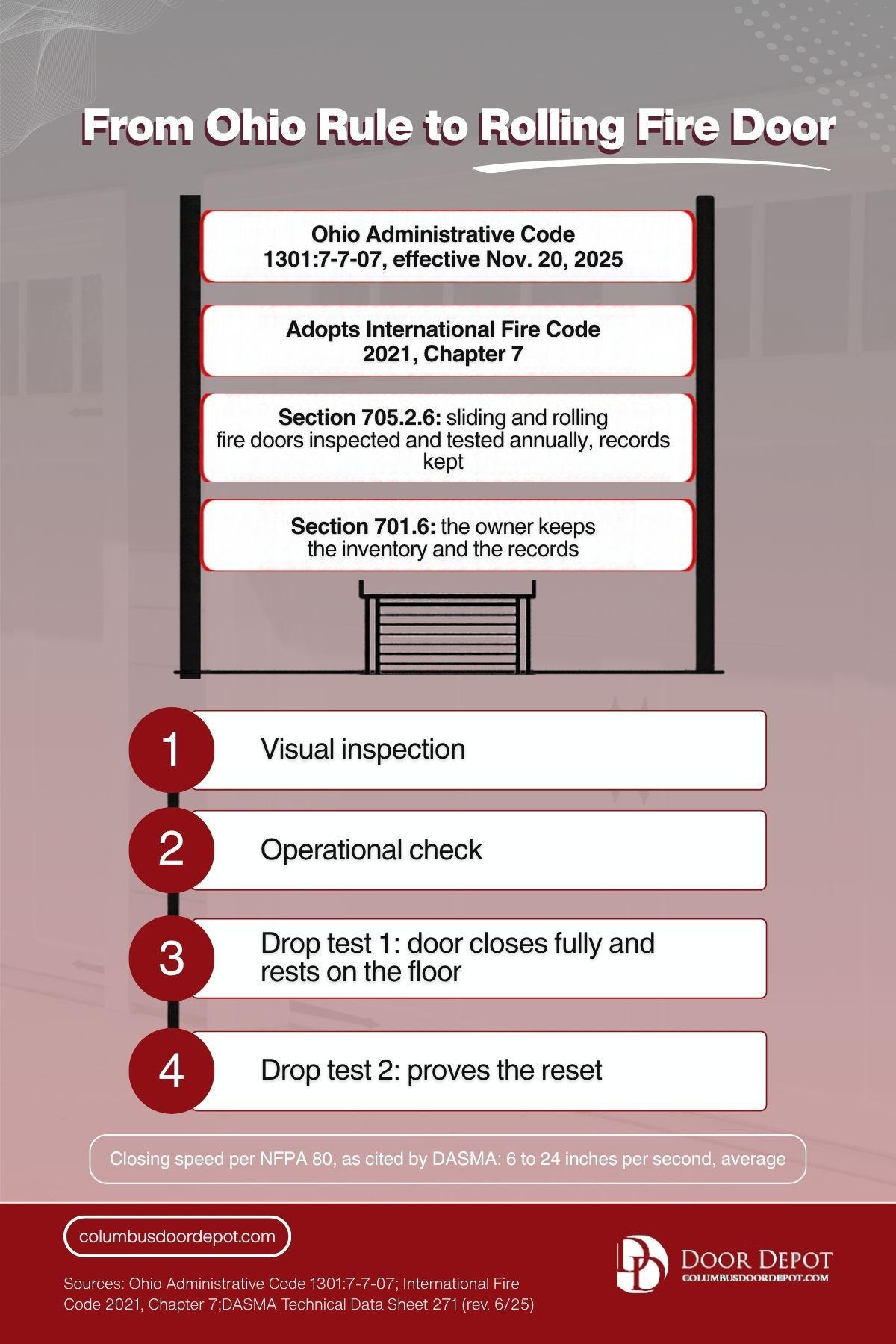
Ohio Administrative Code rule 1301:7-7-07, effective November 20, 2025, adopts Chapter 7 of the 2021 International Fire Code and changes only three sections of it, none of them the fire door rules. Inside that chapter, 705.2.6 requires horizontal and vertical sliding and rolling fire doors to be inspected and tested annually to confirm proper operation and full closure, and requires records. Under 701.6, the inventory, the yearly visual check, and the records belong to the owner. DASMA, the door and operator makers' association, describes the test as a visual inspection, an operational check, and two drop tests, done by a trained rolling steel fire door technician. A door that fails is an unsafe condition under 701.7, and the fire code official decides the fix. Ask for a written result for every door, every year.
Where Does the Annual Test Come From in Ohio?
It comes from the Ohio Fire Code, which borrows the wording from a national model code. The Ohio Division of State Fire Marshal writes the state's minimum fire safety rules and publishes them as Ohio Administrative Code rules 1301:7-7-01 through 1301:7-7-80. The State Fire Marshal's own page names the 2025 Ohio Fire Code as the current version. Rule 1301:7-7-07 is the chapter on fire and smoke protection features.
That rule does very little writing of its own.
Ohio Administrative Code rule 1301:7-7-07 says Chapter 7 of the International Fire Code, 2021 edition, is incorporated by reference, then modifies three sections: 701.1 (scope), 701.6 (owner's responsibility), and 701.7 (unsafe conditions). Two of those edits only swap the phrase "International Building Code" for "building code". The third points to the imminent danger language in the Ohio Revised Code. The door rules in 705 come through untouched.
So the text that governs a rolling fire door in a Hilliard warehouse is the text of the
International Fire Code, 2021 edition, Chapter 7, read as Ohio law. The testing rule, 705.2.6, is one sentence plus a records line:
"Horizontal and vertical sliding and rolling fire doors shall be inspected and tested annually to confirm proper operation and full closure."
| Layer | Document | What it contributes |
|---|---|---|
| State | Ohio Administrative Code 1301:7-7-07, effective 11/20/2025 | Adopts IFC 2021 Chapter 7, edits 701.1, 701.6 and 701.7 only |
| Model code | IFC 2021, Section 705.2 | Opening protectives inspected and maintained per NFPA 80 |
| Model code | IFC 2021, Section 705.2.6 | Rolling and sliding fire doors tested annually, records kept |
| Standard | NFPA 80 | The inspection and maintenance standard the code points to |
| Trade guidance | DASMA Technical Data Sheet 271 | A step order and a test form built on NFPA 80 |
One honest gap. The parent rule, 705.2, sends opening protectives to NFPA 80, the national standard for fire doors, for inspection and maintenance. We could not read NFPA 80 itself for this article, so we do not quote its procedure here. Where this page describes the test, it says whose description it is.
The Owner Carries the Duty
Under 701.6, the owner keeps an inventory of required fire-resistance-rated construction, including the opening protectives covered by Sections 703 through 707, inspects it visually once a year, repairs what is damaged, and keeps records. A test that left no paper behind is a test the fire code official cannot see.
A landlord in Dublin may own the shell while a tenant runs the dock. The code names the owner; who pays is a lease question worth settling in writing early.
- The owner keeps the inventory, does the yearly visual check under 701.6, keeps the records under 701.6 and 705.2.6, and makes sure the annual test happens.
- A trained technician runs the inspection and drop tests, resets the door, and records pass or fail for each step (DASMA's description).
- The fire code official decides whether a door that does not work is acceptable, and what repair or replacement brings it back into line.
Which Doors Does This Cover?
Every horizontal or vertical sliding fire door and every rolling fire door, under 705.2.6. The rule is about the door's job, not about how often it moves.
That catches people out. A rolling fire door can sit coiled in a hood above a firewall opening for years without moving. DASMA's guidance states that the annual inspection and drop test apply to all fire doors, including ones that are not used and stay in the closed position.
The general clause, 705.1, sets the frame: the inspection and maintenance rules reach opening protectives that were required when the building was originally constructed.
How to tell a fire door from an ordinary rolling steel door
They can look alike from the floor. The difference is the closing hardware and the label. DASMA's visual inspection list checks the bottom bar for a "missing listing agency label", and names fusible links, release arms and an automatic closing mechanism as parts of the assembly. A plain service door on a loading dock in Grove City has none of those.
What Happens During a Drop Test?
A drop test checks the automatic closing that the fire door label promises: the door is released through its closing mechanism and has to come all the way down.
DASMA Technical Data Sheet 271, revised in June 2025, lays out four steps, in order, with the results written on a form.
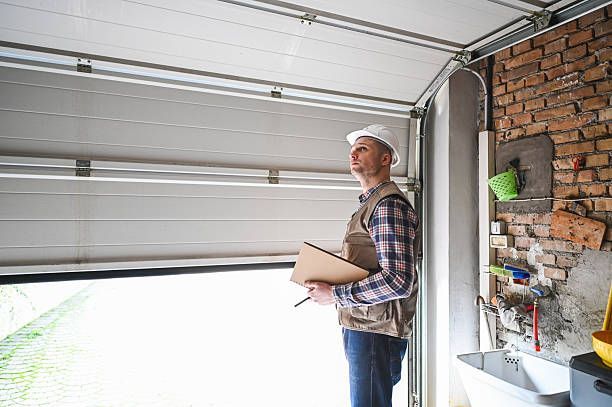
- Pre-test visual inspection. Tape off both sides of the opening, then go over the door for anything that would cause a hazard during the test or stop it from working or resetting.
- Operational test. Fix what the visual check found, clear the doorway, then open and close the door by normal operation while watching for damaged parts or odd movement.
- Drop test one. Correct anything the operational test turned up, open the door fully, and release it using the manufacturer's drop test instructions. It must close completely and rest on the sill or floor.
- Drop test two. Look for parts that failed during the first drop, replace them with original manufacturer parts, and run the drop again. The second drop proves the automatic closing device was reset properly.
DASMA's sheet adds two things worth knowing before the technician arrives. Each automatic closing option on the door gets tested, along with the detectors and release devices that trigger it. The door also has to come down at a controlled pace: citing NFPA 80, DASMA gives an average closing speed of no more than 24 inches per second and no less than 6.
None of this is a quick look. Budget for the opening being taped off and out of use while it happens, which on a busy dock means picking the hour.
The Walkaround That Comes Before Any Drop
Most of what DASMA's sheet lists for the pre-test inspection is visible from a ladder. That makes it the part an owner or facility manager can understand, even though the test itself belongs to a trained technician.
| What gets checked | What a problem looks like |
|---|---|
| Mounting and assembly bolts | Missing or loose |
| Fusible links | Painted, coated in dust or grease, or not where the maker put them |
| Chain, cable and raceways | Kinked or pinched cable, twisted chain, an obstructed raceway |
| Things attached to the door | A suspended ceiling, light fixture, duct, conduit or framing fixed to any part of the assembly |
| Slats and endlocks | Bent, torn or holed slats; missing or broken endlocks |
| Bottom bar | Bent angles, loose bolts, no listing agency label |
| Guides | Bent channels, loose bolts, the curtain entering out of line |
| Hood and fascia | Bent, rubbing the curtain, holes, loose fasteners |
| Automatic closing mechanism | Missing or broken parts; drop or release arms tied, blocked, or wedged |
Note the row about things attached to the door. Conduit and ceiling grid fixed to a fire door assembly come from other trades, not the door, and DASMA lists them anyway.
When the Door Does Not Close All the Way
A rolling fire door that stops short is not a cosmetic fault. Under Section 701.7, a component in this chapter that is not maintained and does not work as intended is deemed an unsafe condition. The fire code official then decides whether it is repaired or replaced, and to which code.
Three other lines in the chapter shape what happens next:
- Section 705.2 says fire doors may not be blocked, obstructed, or made inoperable; fusible links get replaced promptly when they have fused or been damaged, and opening protectives may not be modified.
- Section 705.2.3 says that while a hold-open device or closer is out of service for repairs, the door it operates stays closed.
- DASMA's sheet says repair parts come from the original door manufacturer, and the door is tested again after repairs to confirm it operates and closes automatically.
DASMA is also blunt about money. Its sheet states that parts may fail during a drop test through no fault of the service provider, and that repairing them may not be included in the price of the test. Read any quote with that in mind. A low test price with no line for repairs is not the same offer as one that spells out how failed parts are handled.
Practically, a door that fails in November means a closed opening or a repair before the next inspection, and possibly both. That is a better problem to have in a quiet week than in the middle of a fire inspection.
What Should a Building Owner Ask For?
Ask for a written result for each fire door, every year, from a named technician whose training you can see. NFPA 80, as quoted in DASMA's sheet, defines the trained rolling steel fire door systems technician as someone with documented training who is qualified through experience in inspecting, testing, and maintaining these doors.
Put these questions to whoever you book, and keep the answers:
| Ask | Why it matters |
|---|---|
| Who does the test, and what documented training do they have? | DASMA's sheet, quoting NFPA 80, calls for a trained technician with documented training |
| Will each door get a visual check, an operational check, and two drops? | That is DASMA's four-step order; a single drop does not prove the reset |
| Will every automatic closing option be tested, with detectors and release devices? | DASMA lists each option separately |
| Do I get a written form per door with pass or fail for each step? | 705.2.6 requires records; DASMA's form records each step |
| Are repair parts from the original manufacturer? | DASMA says replacement parts come from the original maker |
| How are parts that fail during the test priced? | DASMA warns repair cost may sit outside the test price |
Records worth keeping in one place
DASMA's test form gives the shape of a good record. For each door, it captures the door location, the opening width and height, the door manufacturer and the manufacturer's serial number, and a pass or fail for the visual inspection, the operational check, and each of the two drop tests. Keep that alongside the 701.6 inventory of your fire-rated construction and the record of any repair, and the annual conversation with the fire code official gets short.
Why November Suits This Visit Around Columbus
The code sets no month. A rolling door stopped short of the floor at a dock in Groveport or Gahanna leaks heat all winter, which argues for finding out now. A fire door that doubles as a working dock door also piles up cycles, the point of our look at how hard a busy commercial door works in a single shift.
Several addresses? Our
commercial door service in Grove City and our work on
fire-rated and dock doors for Gahanna businesses run on the same routes as Columbus, Westerville, and Hilliard.
Get the Fire Door Paperwork in Order Before the Inspector Asks
List every rolling and sliding fire door with its location and maker, then find last year's form for each. A door with no form is the first call.
We install and repair rolling steel doors and fire-rated door systems for businesses across Columbus, Dublin, Westerville, Hilliard, and Grove City. If your annual test turns up a curtain, guide, operator, or closing part that needs fixing, that falls under our commercial garage door repair work, and our installation and repair team for Columbus homes and businesses covers new fire-rated openings too. Reach us through Columbus Door Depot and tell us which door failed.
Frequently Asked Questions
How often does a rolling fire door inspection have to happen in Ohio?
Once a year at minimum. The Ohio Fire Code adopts Section 705.2.6 of the 2021 International Fire Code, which requires sliding and rolling fire doors to be inspected and tested annually for proper operation and full closure, with records of the inspection and testing kept.
Who is responsible for testing a rolling fire door?
The building owner. Section 701.6, as adopted in Ohio, puts the inventory, the yearly visual inspection, and the records on the owner. DASMA's guidance says the inspection and drop test itself should be done by a trained rolling steel fire door technician.
What is a rolling fire door drop test?
DASMA describes it as releasing the door through its automatic closing mechanism to confirm it closes completely and rests on the sill or floor. Its sheet calls for two drops after a visual and an operational check, with the reset proven on the second.
Does a fire door that is never used still need testing?
Yes. DASMA's Technical Data Sheet 271 says the annual inspection and drop test requirement applies to all fire doors, including ones that are not used and remain in the closed position. The code's wording covers every rolling and sliding fire door.
What happens if a rolling fire door fails its test?
Under Section 701.7, a component that does not function as intended is an unsafe condition, and the fire code official decides whether it is repaired or replaced. DASMA says repairs use original manufacturer parts and the door is tested again afterward.